



Prividium in Japan: a full stack platform for the world's most deposit-rich banking system
Prividium and NexBridge are bringing private, institution-controlled blockchain infrastructure to Japan, connecting regulated digital assets to Ethereum.


Published Jan 13, 2026
The mission of ZKsync is to advance freedom by accelerating the mass adoption of crypto. Over eight years in the industry, I became convinced that this mission will only succeed if crypto becomes an indispensable part of the global economy rather than a parallel system.
Real-world financial systems operate under hard, non-negotiable regulatory and business realities. Over the past year, our extensive discussions with global institutions (including banks, enterprises, and governments) converged on four major requirements:
Earlier generations of crypto protocols were architecturally incapable of meeting these demands without fundamental compromises. ZK technology is the only path forward for blockchain systems to become part of real-world finance.
Zero-knowledge proofs make it possible to preserve privacy, enforce rules, and guarantee system ownership with cryptographic correctness, while supporting isolated, high-performance execution connected to public blockchains.
As experts in ZK and institutional infrastructure, we recognized early that no one else in crypto was better positioned to do this work. We made a deliberate decision to build for real-world constraints rather than industry shortcuts. That meant rejecting many practices that are popular in this industry but incompatible with a serious, long-term approach.
Those choices are now embedded into the ZKsync architecture and are not reversible. They form the foundation of Incorruptible Financial Infrastructure, where trust is anchored in cryptography rather than human operators or intermediaries.
In 2025, as regulatory conditions shifted decisively in our favor, we moved from preparation to focused execution.
We entered 2025 with a concrete technical roadmap and executed it end-to-end.
Atlas, Prividium, Airbender were built as a single cohesive system, and that system went live with ADI Chain, alongside more institutional deployments already underway.
A brief assessment of where we landed:

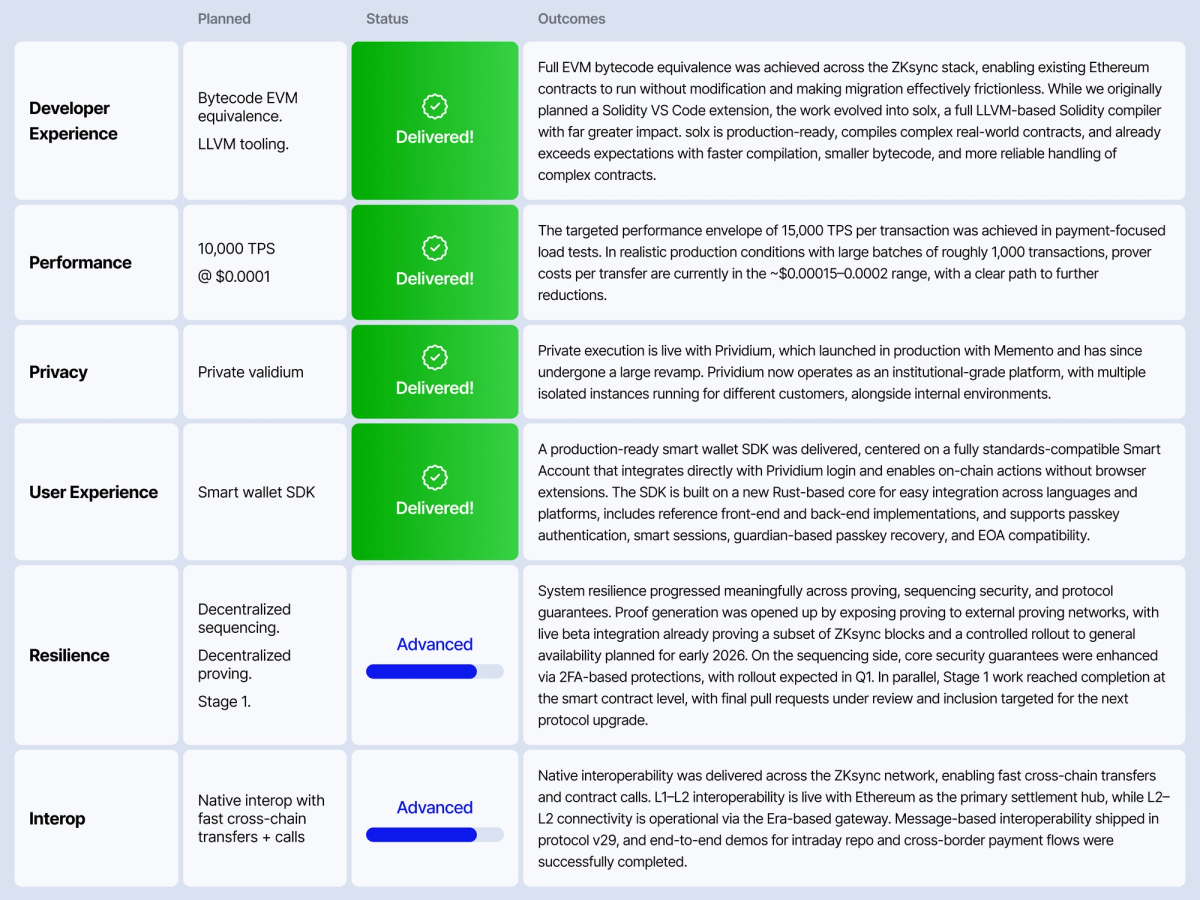
List of deliverables: matterlabs.notion.site/shiplist.
Most commitments were delivered in full, in production, and under real load. As real-world use clarified what mattered most, execution expanded beyond the original scope in several areas, while in a small number of cases scope was deliberately adjusted or deprioritized.
2025 was about foundations. 2026 is about real-world use cases.
This year, we will compound what already exists and unlock new classes of applications that were previously impossible or impractical. The foundations laid in 2025 now allow us to move beyond isolated improvements and focus on enabling real-world use cases that require privacy, performance, coordination, and operational maturity.
Here is what to expect.

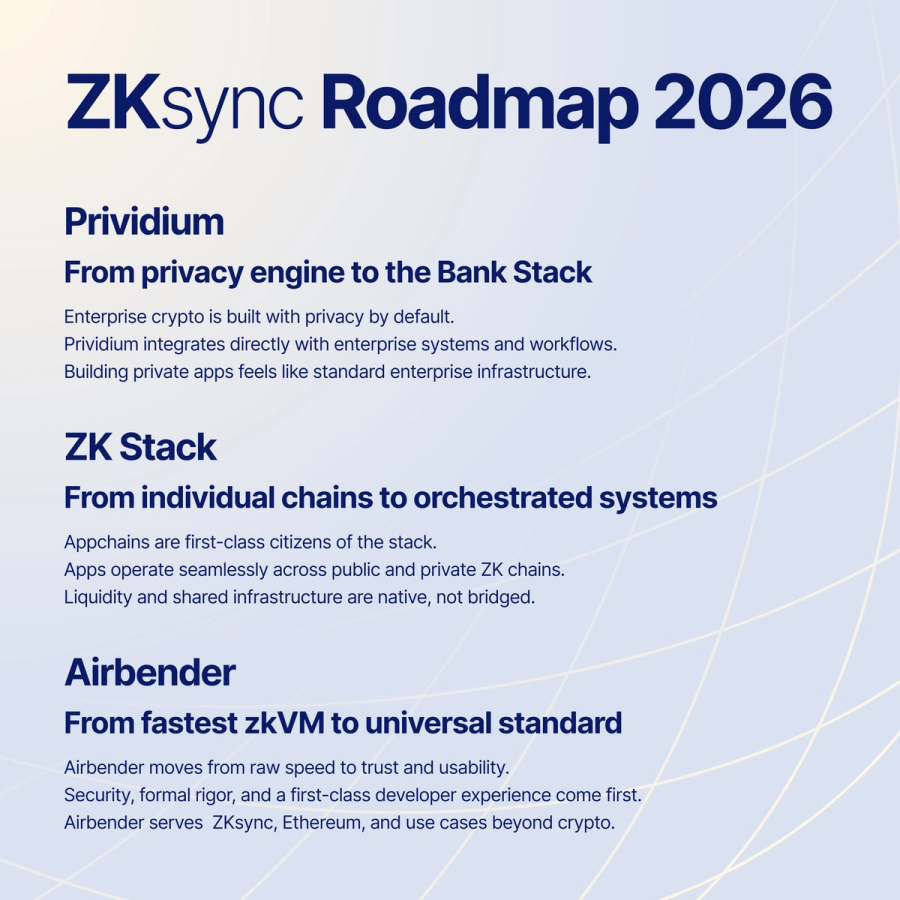
Privacy will be the most important moat in crypto. Prividium already represents the most advanced blockchain platform for privacy: fully EVM-compatible, expressive, and production-ready. Developers can build private applications without rewriting code in esoteric languages, abandoning Ethereum tooling, breaking familiar UX flows, sacrificing liquidity or composability.
Building on this foundation, 2026 is about making privacy the default starting point for enterprise applications. The focus shifts from proving technical capability to making private execution seamless in real production environments.
This means integrating privacy directly into existing enterprise workflows and systems: identity and access management, transaction approval flows, reporting, auditing, and integration with existing financial and operational software. Building and operating private applications on ZKsync will feel natural for teams used to enterprise infrastructure, not like adopting a separate crypto stack.
The Atlas upgrade turned the ZK Stack into the highest-performance production L2 stack, designed to support institutional and enterprise-grade chains under real load. It delivered native EVM compatibility and infrastructure built to operate reliably at scale.
In 2026, this foundation evolves into a platform where appchains are first-class citizens and multiple chains can be orchestrated as a single system. Applications will be able to access liquidity, execution, and shared services across public and private ZK chains, including Ethereum, without external bridges or bespoke integrations. Cross-chain behavior will be native, composable, and largely invisible to both users and developers.
The result is that ZK Stack becomes the default choice for building appchains. Performance isolation, native connectivity, shared services, security primitives, and bootstrapping infrastructure will all be available out of the box. If you need your own chain, ZK Stack will offer the most direct path to production, with far less operational complexity and far greater composability than fragmented alternatives.
Airbender is already the fastest RISC-V zkVM in the world. In 2026, we will focus on making it the most trusted and widely usable zkVM as well, through deeper auditing, formal verification, and significant improvements to developer experience. Airbender will be usable well beyond the ZKsync Stack, supporting Ethereum’s long-term ZK-centric roadmap and any system that requires high-performance verifiable computation, with the goal of establishing it as the default zkVM standard across crypto and beyond.
--
Enterprise crypto adoption was blocked not only by regulatory uncertainty, but by missing infrastructure. Systems could not protect sensitive data, guarantee performance under peak load, or operate within real governance and compliance constraints. As a result, serious deployment remained out of reach even as the regulatory environment improved.
That block is now removed. With Incorruptible Financial Infrastructure in place, ZKsync provides the foundations required for real-world deployment: privacy by default, deterministic control, verifiable risk management, and native connectivity to global markets.
2026 is the year ZKsync moves from foundational deployments to visible scale. Our focus is on deep institutional partnerships rather than broad, speculative adoption. Several of these partnerships were initiated in 2025 and are already progressing through production readiness, with additional engagements now underway. We expect multiple regulated financial institutions, market infrastructure providers, and large enterprises to launch production systems on ZKsync, serving end users measured in the tens of millions rather than thousands.
These partners operate across payments, capital markets, trade finance, and regulated digital asset infrastructure, collectively addressing trillions of dollars in annual transaction volume and multi-trillion-dollar total addressable markets.
What follows is adoption at scale.
- Alex
Prividium and NexBridge are bringing private, institution-controlled blockchain infrastructure to Japan, connecting regulated digital assets to Ethereum.

NexBridge and Matter Labs partner to bring Prividium to Japan’s financial institutions for private digital asset issuance, settlement and tokenization.

Matter Labs CEO Alex Gluchowski on open source as the answer to vendor dependency in financial infrastructure, and a central bank running public code.