


Private where it matters.
Connected where it counts.
Prividium is the only Ethereum-secured blockchain platform purpose-built for institutions that demand privacy, compliance, and full control of their data.
"At Memento, we're dedicated to transitioning traditional finance on-chain. Our work with Deutsche Bank on a ZK Chain based platform simplifies and accelerates asset tokenization and fund management reducing complexity and costs while ensuring compliance and privacy for the financial products"
Nicole Lanteri
CEO at Memento


Global markets are moving onchain.
Connect without tradeoffs.
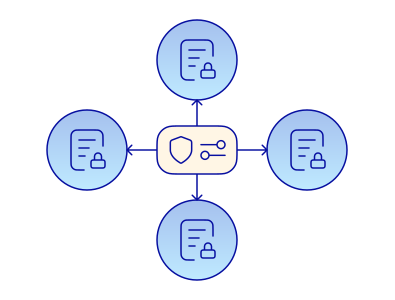
Privacy with operator control
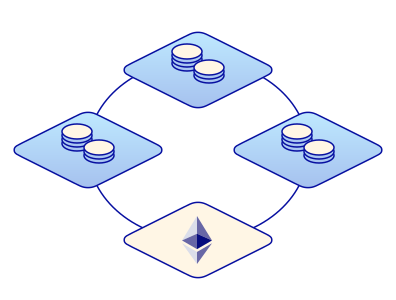
Direct market access
No third-party risk
The Prividium® difference
 Public Verifiability
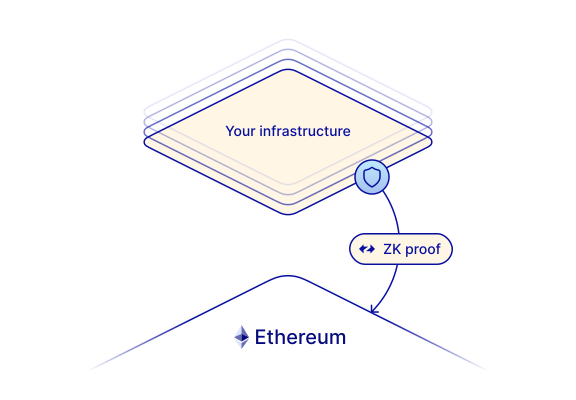
Transactions execute privately
All activity runs inside your infrastructure, keeping sensitive data from leaving your environment.
Controlled disclosure
Regulators or partners see only the information they are authorized to access.
ZK proofs certify correctness
Every batch generates ZK proofs that attest to validity without exposing raw data.
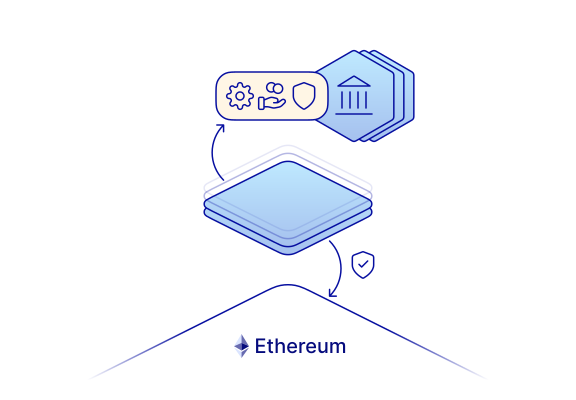
Finality on Ethereum
Proofs are anchored to Ethereum, providing transaction finality with the strongest available security guarantees.Prividium® is a full ZK-based blockchain that keeps data private within your infrastructure.
Designed for enterprises, Prividium offers user-level privacy, compliance, cross-chain connectivity, and Ethereum-grade security out of the box.
Privacy with public proofs
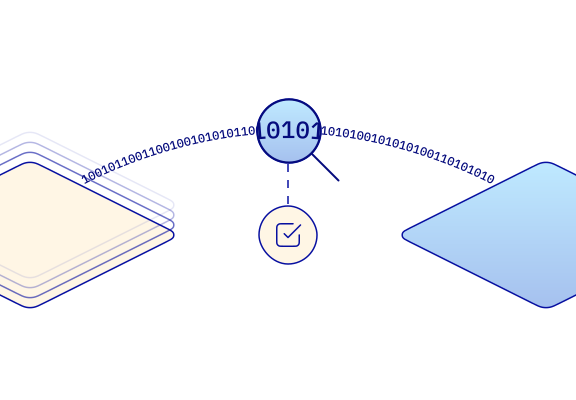
Built-in compliance
Enterprise control with scale
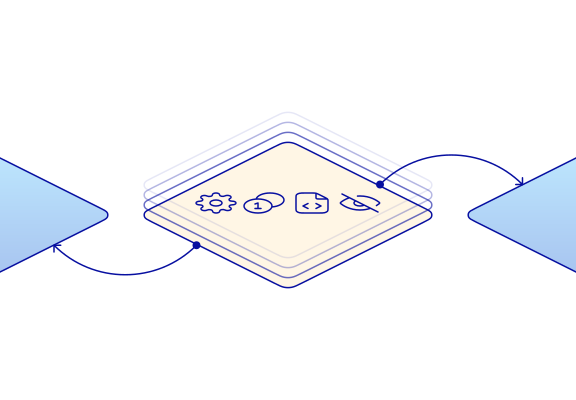
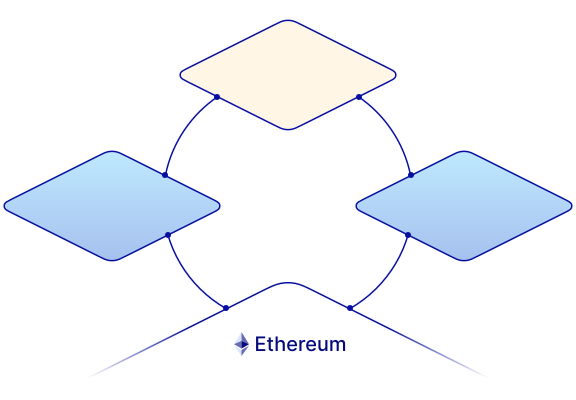
Direct connectivity
Independent security assurance:
SOC 2 Type I for Prividium®
Matter Labs has completed a SOC 2 Type I examination for the Prividium® platform, independently conducted by Thoropass Assurance against the AICPA Trust Services Criteria for Security, Availability, Confidentiality, and Privacy. The examination provides third-party assurance on the design of Prividium’s controls as of May 29, 2026.
- Standard
- SOC 2 Type I (AICPA Trust Services Criteria)
- Scope
- Security · Availability · Confidentiality · Privacy
- Auditor
- Thoropass Assurance, independent service auditor
- As of
- May 29, 2026
SOC 2 is among the most widely recognized standards in enterprise vendor due diligence. The full report is available to prospective and existing customers under NDA. The report also establishes a documented control baseline for Matter Labs’ planned SOC 2 Type II examination, which is expected to assess operating effectiveness over time.
Why enterprises move to Prividium®

From permissioned ledgers

From public chains
Prividium® enables new use cases
Faster, compliant global payments
Cross-border payments between regulated entities
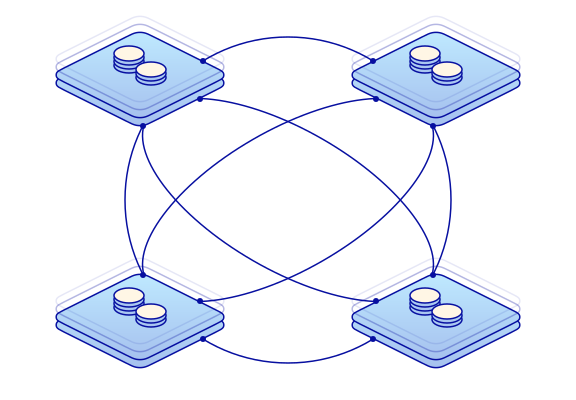
Full lifecycle for digital assets
Digital asset issuance and lifecycle management
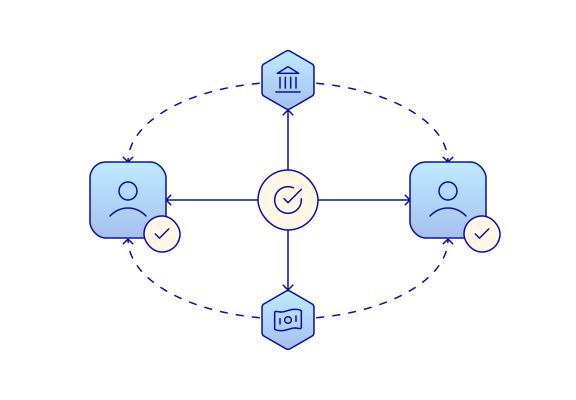
Compliant markets, verified participants
KYC-anchored tokenized markets
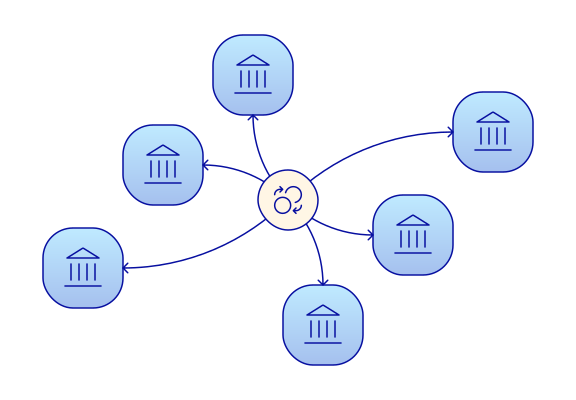
Secure cross-chain financial products
Atomic swaps and cross-chain finance between institutions
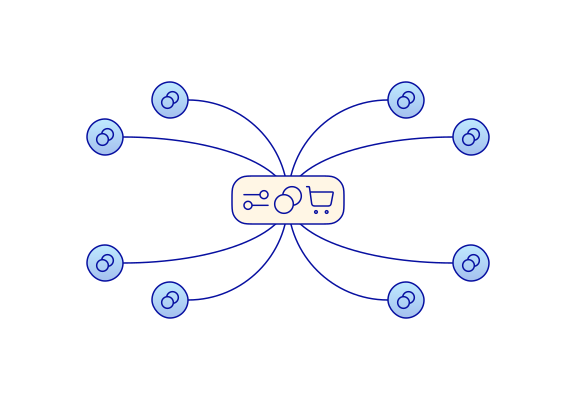
Real-time intraday liquidity
Intraday repo and secured financing
Research & case studies
Blockworks Research · 2026
The Race to Reinvent the Deposit
The latest Blockworks report on the future of tokenized deposits and their co-existence with stablecoins. Stablecoins and deposit tokens are not substitutes. Stablecoins are open, permissionless dollars for settlement and DeFi. Deposit tokens are regulated bank money for vetted counterparties and the onchain economy needs both.
Tokenization at Investment Banks Report
The largest ever industry-wide survey of investment banks on how tokenization and digital assets are impacting their business, sharing granular information on the impact of tokenization use cases across Collateral Mobility, Tokenized Repo, Tokenized FX, and Tokenized Equity Capital Markets.
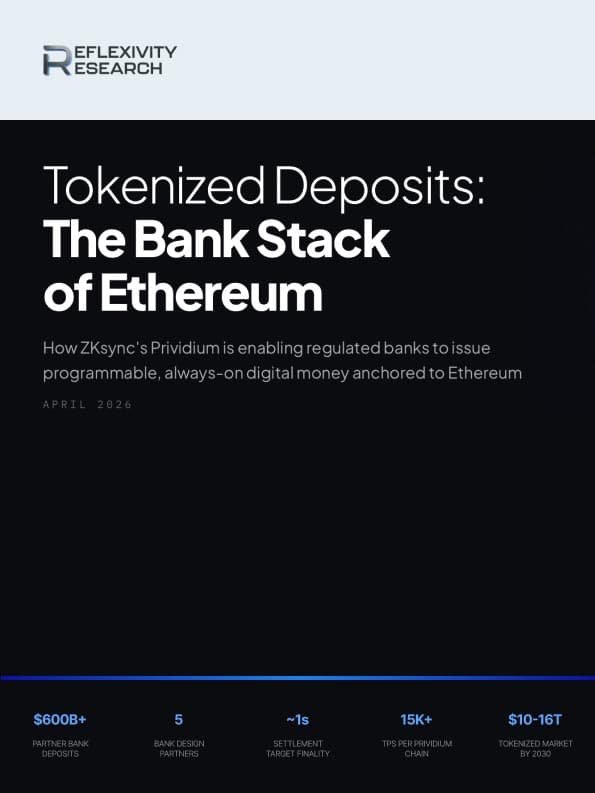
Reflexivity Research · 2026
Tokenized Deposits: The Bank Stack of Ethereum
How ZKsync's Prividium is enabling regulated banks to issue programmable, always-on digital money anchored to Ethereum. The report covers how tokenized deposits combine the programmability of blockchain with the trust, insurance, and regulatory framework of the traditional banking system — and why ZKsync is becoming the institutional settlement layer.
- The Cari Network, founded by the 27th U.S. Comptroller of the Currency, is onboarding five major U.S. regional banks with $600B+ in combined deposits onto ZKsync's Prividium, targeting a Q3 2026 pilot
- Prividium resolves the decade-long bank dilemma of control vs. connectivity — private execution with public verifiability through zero-knowledge proofs, no trusted operator required
- $5.7 trillion in adjusted stablecoin volume in 2024 proved demand for digital dollars; tokenized deposits bring those same capabilities into regulated banking with deposit insurance and yield
- 35+ financial institutions have validated the Prividium architecture; BitGo brings federally chartered custody to the Bank Stack alongside the Mid-Size Bank Coalition of America's endorsement

ZKsync / Matter Labs · 2025
Beyond Public vs. Private Chains: The Prividium® Breakthrough
ZKsync Prividiums are private, permissioned Ethereum-secured Layer 2s that combine institutional privacy, compliance, scalability, and interoperability into a single enterprise-ready framework. Validated by 35+ financial institutions across live demos of cross-border payments and intraday repo, Prividiums address the fundamental tradeoff between public chain transparency and private ledger silos — enabling near-instant, confidential settlement anchored to Ethereum's security.
- Private L2s keep all transaction data off-chain while posting only ZK proofs to Ethereum, delivering AI-resistant institutional privacy with selective regulator access
- Native cross-chain interoperability eliminates third-party bridges, enabling atomic FX + settlement across independent bank-operated chains
- 10,000+ TPS at sub-second latency with proving costs under $0.0001 per transaction — orders of magnitude cheaper than legacy rails
- Cross-border payments demo showed near-instant settlement replacing 3–5 day correspondent banking flows that immobilize ~$27 trillion in nostro/vostro accounts
- Intraday repo demo delivered 24/7 atomic settlement of cash and collateral via smart contracts, eliminating manual reconciliation and timing mismatches
Reflexivity Research · 2025
Memento ZK Chain: Creating the Future of Onchain Fund Management
Memento blockchain, in collaboration with Deutsche Bank, has deployed a live institutional Layer 2 powered by ZKsync Prividium to modernize fund management. Deutsche Bank's DAMA 2 platform — originating from Singapore's Project Guardian — is the first institutional use case, enabling tokenized fund issuance, distribution, and servicing with embedded privacy and compliance. After testing five different blockchain ecosystems, Memento selected ZKsync for its combination of Ethereum-grade security, institutional privacy, and modular compliance tooling.
- Deutsche Bank's DAMA 2 is the first institutional use case live on Memento ZK Chain, providing a full-stack platform for tokenized fund issuance, distribution, and servicing
- Fund deployment compressed from 2–3 months to 2–3 weeks, with near-instant redemptions replacing multi-day settlement cycles
- Three-layer architecture (DAMA 2 app layer → Memento ZK Chain infrastructure → Ethereum settlement) keeps transaction data private while anchoring integrity via ZK proofs
- $50B+ in potential annual savings identified from reduced intermediary reliance in fund management
- Multichain distribution across 70+ chains planned via Axelar integration (ETA Q4 2025), enabling tokenized funds to scale across blockchain ecosystems
Delphi Consulting · 2025
ZKsync: The Elastic Network Endgame
Delphi Consulting's institutional accelerator report examines ZKsync's transformation from a single ZK rollup into the Elastic Network — a modular ecosystem of interoperable ZK Chains built on the open-source ZK Stack. The report argues that ZK proof technology is the key to solving blockchain's dual challenge: liquidity fragmentation across 30+ L2s and public chains' inability to meet institutional demands for privacy, compliance, and customization. With $1.19B in total economic value and 13+ new ZK Chains onboarding, ZKsync is positioning across tokenization, gaming, social, and permissioned enterprise use cases.
- Three-pillar architecture (ZK Router, ZK Gateway, ZK Chains) enables trustless cross-chain interoperability with shared liquidity, ~1s soft confirmations, and no third-party bridge dependencies
- Enterprise adopters include Deutsche Bank (asset tokenization), Buenos Aires government (digital identity for 3.6M residents), Tradable ($1.7B tokenized private credit), GRVT (regulated hybrid DEX), and Lens (decentralized social media)
- ZKsync leads all rollups in theoretical throughput at 434 TPS with the second-lowest block time; 2025 roadmap targets 10,000 TPS at $0.0001 per transaction
- Modular ZK Chain design lets enterprises choose chain type (rollup/validium), data availability, gas token, sequencing model, and permissioned vs. permissionless access — enabling confidentiality with verifiability
- ZK token (21B supply, ~$687M circulating market cap) serves governance, network fees, and future validator staking; three-body governance model (ZKsync Governance, Security Council, Guardians) implements separation of powers
The Block Research · 2024
The Future of Tokenization: How ZKsync Is Changing the Game
The Block Research report examines how ZKsync's Elastic Chain architecture is positioned to capture the projected $10–16 trillion tokenized asset market by 2030. The report argues that while tokenization of real-world assets has already surged past $11 billion, the industry has yet to achieve full on-chain issuance and value transfer — and that ZKsync's combination of scalability, customization, confidentiality, security, and native interoperability addresses the key technical and enterprise-readiness blockers preventing that transition.
- 97% of institutional investors (BNY Mellon/Celent survey) agree tokenization will revolutionize asset management; BCG/ADDX project a $10–16T tokenized asset market by 2030
- ZKsync's Elastic Chain enables full on-chain issuance by eliminating intermediaries, minimizing counterparty risk, enabling real-time settlement, and improving liquidity through automated smart contracts
- Modular ZK Stack lets enterprises customize chain type, gas token, data availability, data visibility, accessibility (permissioned/permissionless), sequencing, and consensus — supporting granular compliance and confidentiality requirements
- Early institutional traction includes Tradable ($500M+ private credit tokenization), Fidelity International ($50M money market fund on ZKsync Era), Deutsche Bank (asset tokenization platform on a ZK Chain), and Buenos Aires government (decentralized digital identity for 3.6M residents)
- Three remaining adoption blockers identified: regulatory clarity, technological robustness, and enterprise readiness — with the Elastic Chain directly addressing the latter two while positioning enterprises to adapt as regulations evolve
Delphi Consulting · 2025
ZKsync & Elastic Network's Q1 2025 Wrapped
Delphi Consulting's quarterly report covers ZKsync's Q1 2025 performance, highlighting ZKsync Era's position as the leading ZK rollup with $780M TVS and 58% of all ZK proof volume on Ethereum. The report tracks the Elastic Network's expansion to 19+ ZK Chains and growing institutional adoption across tokenized assets, decentralized exchanges, and digital identity.
- ZKsync Era is the leading ZK rollup — $780M TVS, 9.97M addresses, 58% of all ZK proof volume on Ethereum, and #2 blockchain for tokenized RWAs ($2B+, 27% market share)
- The Elastic Network grew to 19+ ZK Chains, with standout launches: Abstract (1.4M wallets in 42 days), Sophon ($138M TVL), GRVT (first licensed DEX, $1.3B volume in 30 days), and GenLayer (AI-native smart contracts)
- Institutional momentum is strong — Tradable tokenized $1.7B in private credit, UBS tested tokenized gold on a ZKsync validium, and WonderFi (1.7M users) is building its own ZK Chain
- ZK Gateway hit testnet (mainnet Q2 2025), ChonkyBFT consensus went live, execution delay dropped from 21→3 hours, and Nethermind formally verified ZKsync's zk-verifier for the first time

Delphi Digital · 2025
ZKsync: Building a Trustworthy Settlement Layer
Delphi Digital examines ZKsync's emergence as a settlement layer for institutional and sovereign finance. The Atlas upgrade delivers one-second finality with 15,000+ TPS sequencing and full EVM equivalence. With 35+ financial firms participating in Prividium workshops and sovereign initiatives like the UAE's ADI Chain, ZKsync positions itself as the settlement layer that regulated finance can actually deploy.
Messari · 2025
ZKsync Prividiums for Enterprise-Grade Privacy
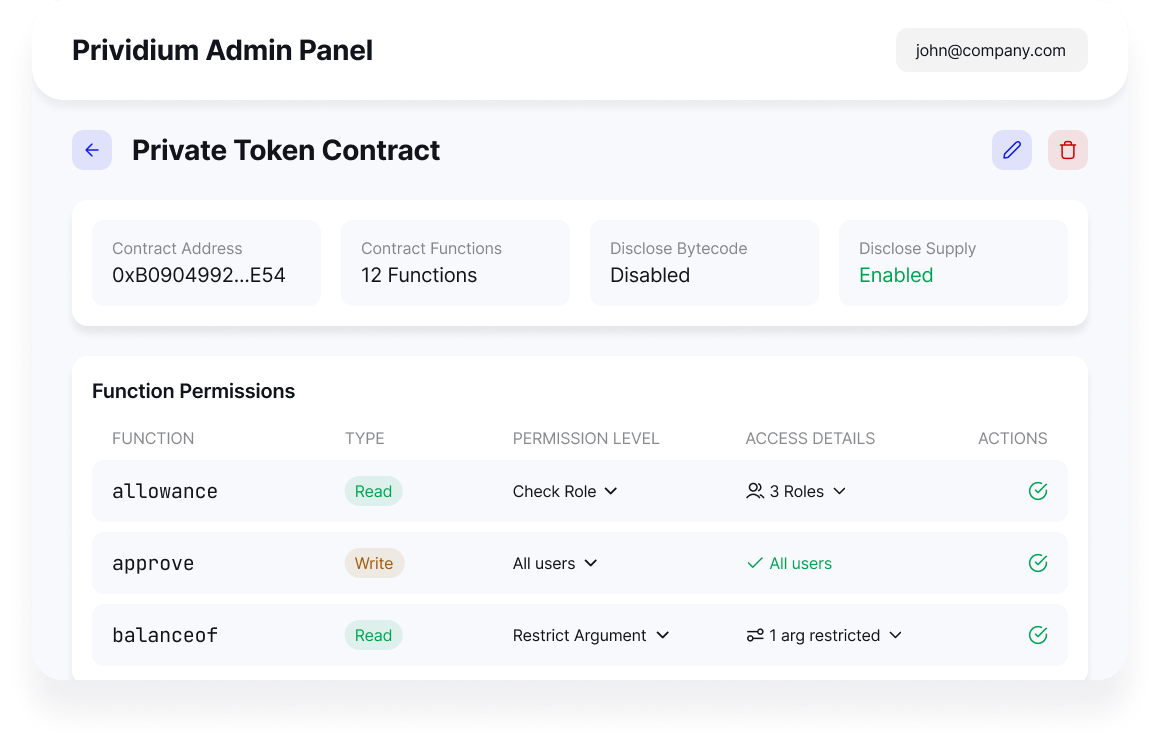
Messari's deep-dive into Prividiums — permissioned validium deployments that run inside an organization's infrastructure, keeping transaction data and state offchain while anchoring correctness to Ethereum through validity proofs. Covers enterprise permissioning with Okta and Azure SSO, contract and function-level access controls, selective disclosure for audit needs, and deployment options from self-hosted to fully managed by Matter Labs.
Production-ready blockchain for regulated finance
Frequently asked questions
Everything you need to know about Prividium.
No. Only ZK proofs are posted to Ethereum. These proofs confirm correctness without revealing underlying data or transaction details.
No. Permissioned ledgers depend on consortium trust. Prividium uses ZK proofs so every block is automatically verifiable. Trust is built into the math, not the governance model.
ZK proofs guarantee that every block is correct, even if there's only a single sequencer. An operator can see and choose which Prividium transactions to include, but they cannot falsify results because invalid blocks will fail verification. This means censorship is possible today, but a malicious or invalid transaction cannot be executed.
Yes. Prividium lets regulators verify balances, flows, or specific fields using cryptographic proofs tied to the Ethereum-anchored state. In practice, operators could also provide offchain reports as they do today. The difference is that with Prividium, regulators have the option to independently verify the data whenever they are ready to adopt the tooling.
Not yet. Today Prividium operates with a single sequencer. Decentralized sequencing is on the roadmap, which will allow multiple operators to share responsibility and reduce censorship risk. Each sequencer in that model will see the full data processed on Prividium.
Add-ons like FHE or mixers only cover certain applications and often add heavy performance costs. They also make data private even from the operator, which creates compliance risks, as seen with mixers. Prividium is a full chain architecture with privacy, compliance, and interoperability built in from the base layer, ensuring confidentiality without breaking regulatory requirements.
No. The core stack is open source and independently audited. Enterprises can operate it themselves, work with Matter Labs for SLAs and enterprise support, or choose other hosting providers. There is no vendor lock-in.