


Introducing Airbender Prime
Airbender Prime proves Ethereum blocks in real time on a single GPU, using hash-based STARKs built for post-quantum security and independent verification.

Published Dec 4, 2025
It feels like every month a new chain appears promising to “fix” DeFi incentives yet every launch repeats the same pattern. Each major DeFi protocol has to redeploy, rebuild liquidity, and chains spin up another liquidity-mining campaign. The result is a structural cold-start problem the entire ecosystem keeps reliving.
Meanwhile, Ethereum continues to hold the lion’s share of crypto-native lending liquidity. What’s been missing is a way for L2s to use that liquidity directly.
For years, L2s have scaled Ethereum’s performance.
Today, for the first time, they can scale Ethereum’s liquidity.
A few weeks ago, we shared for the first time our vision about Ethereum turning into the main capital hub of the ZKsync ecosystem, enabled by our Atlas upgrade.
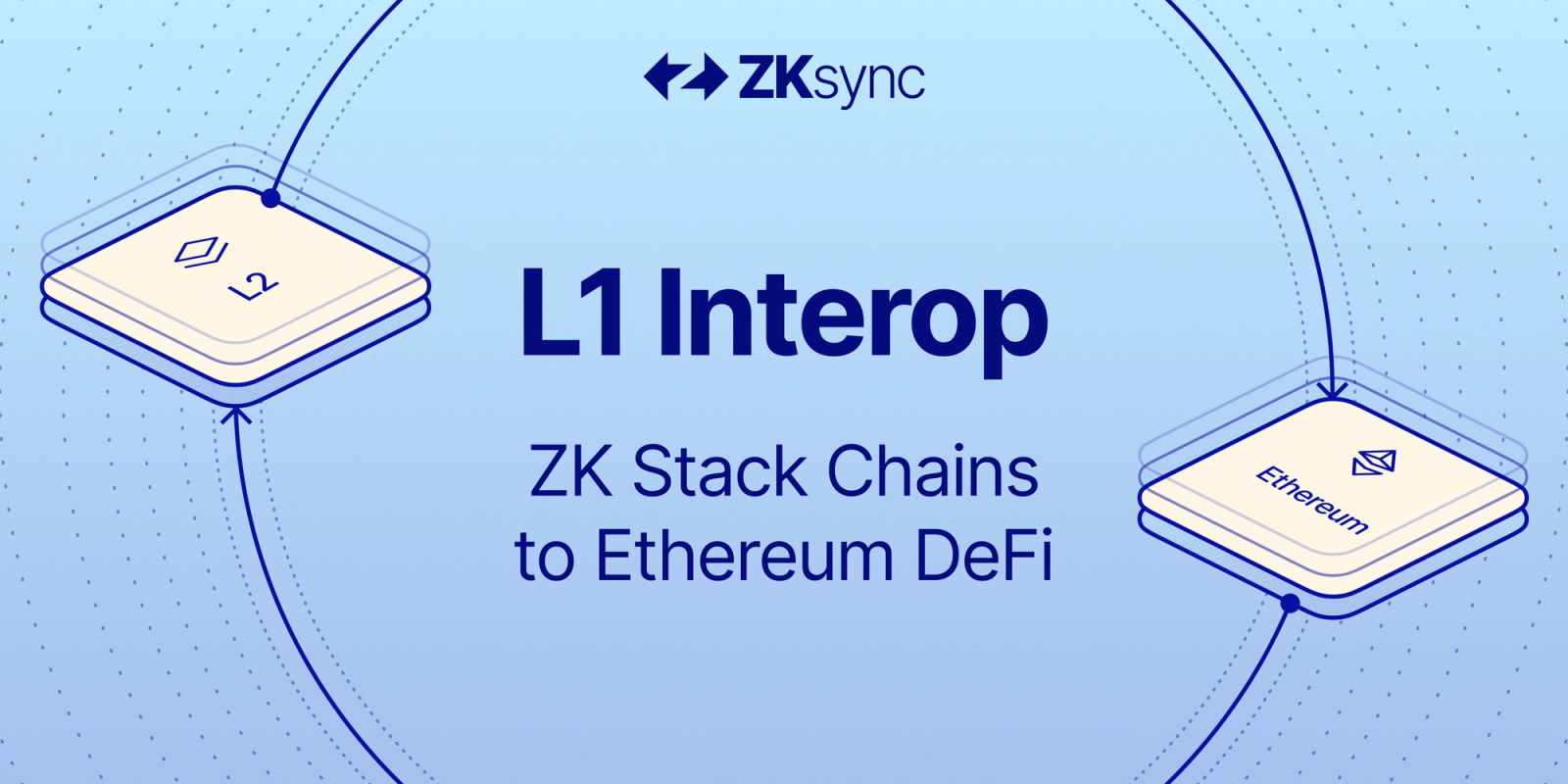
L1 Interop makes it possible for any ZK Stack chain to tap Ethereum DeFi natively without giving up its own governance, privacy, or execution environment. A user on a ZK Chain can deposit into Aave or borrow GHO on Ethereum with no fragmented liquidity and no slow bridges.
Paired with Prividiums, this becomes the first architecture where institutions get private systems and seamless access to public-market liquidity.
From the user’s perspective, the experience is simple, with the protocol handling the mechanics of the L2 ↔ L1 interaction. The user signs a transaction at L2 just as they would a normal L2 transaction, but in this case it triggers the following steps:
deposit() on Aave and then borrow() GHO against that collateral).From the user’s point of view, they never have to switch networks or manage a separate L1 wallet, but they can still tap into the deep public liquidity of the Ethereum DeFi ecosystem.
This design pattern unlocks powerful use-cases for enterprises and institutions wanting to build on Ethereum.
Teams operating a Prividium can use this pattern without compromising privacy. Their users get:
ZKsync’s Interop becomes a powerful tool for corporate finance teams. They can move assets between ZK Chains and Ethereum L1 in minutes to:
Private operations stay on their chain; market interactions happen on L1.
For trading firms, exchanges, and structured product issuers, this model allows them to:
This gives institutional markets the best of both worlds: L2 performance with L1 liquidity and solvency guarantees.
Many institutional Ethereum integrations today still rely on omnibus accounts.
L1 Interop flips that model.
With ZK Chains and Prividiums, each user has an aliased account on Ethereum. When they deposit, post collateral, or provide liquidity into a DeFi protocol like Aave, they do so directly from that account.
As users interact with real L1 protocols rather than fenced-off replicas, they also inherit the full composability of Ethereum.
This is the concrete realization of the idea that “Ethereum is now the main capital hub of ZKsync.”
Enterprises no longer have to choose between private, compliant systems on the one hand and Ethereum’s liquidity, market depth, and trust guarantees on the other.
With L1 Interop, they keep sovereignty over their own chain, gain native access to Ethereum, and give their users a single wallet, a single identity, and a seamless bridge between institutional workflows and the world’s most valuable on-chain financial ecosystem.
Want to learn more? Get in touch with us!
Airbender Prime proves Ethereum blocks in real time on a single GPU, using hash-based STARKs built for post-quantum security and independent verification.


Prividium and NexBridge are bringing private, institution-controlled blockchain infrastructure to Japan, connecting regulated digital assets to Ethereum.

NexBridge and Matter Labs partner to bring Prividium to Japan’s financial institutions for private digital asset issuance, settlement and tokenization.