


Published Apr 17, 2026
Quadrillions are at stake: Alex Gluchowski on bringing banks onchain
Transcript
Alex Gluchowski on Bringing Banks Onchain: Matter Labs, ZKsync, and the Cari Network
An interview with Alex Gluchowski, co-founder and CEO of Matter Labs, on tokenized deposits, zero-knowledge proofs, and how public blockchains are becoming the backbone of global finance.
Host: Welcome to the show, Alex. For viewers and listeners at home, can you introduce yourself and tell us about Matter Labs?
Alex Gluchowski: Matter Labs is a company that was founded eight years ago on a mission to help scale public blockchains with zero-knowledge proof technology — an amazing breakthrough in cryptography that has developed over the last thirty years, with the last couple of years taking it to a whole new level. I believe this is going to be something that powers all of world finance in a few years.
We've been pioneers of this stack on Ethereum and have contributed to a number of innovations in the space. Now we're focused on what I believe is the largest opportunity crypto has seen in its entire history: onboarding traditional financial institutions, banks, and enterprises onto blockchain rails.
Just how big is the TradFi opportunity?
Host: When you say "the largest opportunity," do we have numbers for how big this is? How big would it be to enable these TradFi institutions to adopt this newer technology?
Alex: I don't have exact numbers, but they're measured in quadrillions, if not more, if you look at the full spectrum of what's at stake.
It starts with payments, then goes into deposits and the tokenization of those. According to some estimates, between one hundred billion and several trillion dollars are stuck in the correspondent banking system — in the nostro/vostro accounts that banks hold with each other to facilitate payments. Then you add RWAs: tokenized stocks, equities, bonds, and so on. This is orders and orders more than everything we've seen in the crypto market so far.
Why tokenization, why now?
Host: Tokenization in general — stablecoins and tokenized deposits. What's at stake for banks, and why now? They've had the potential to do this for a while.
Alex: Several factors are coming together at this exact point in time.
Banks have been experimenting with blockchains for a while. They're naturally more conservative organizations — risk-averse, moving a little slower, testing things very thoroughly at the technical due diligence level. Most large banks already operate their own private blockchain systems today, normally based on Ethereum or EVM technology, and use them for internal operations.
You can think of these as an upgrade over traditional banking databases. With smart contracts and blockchains run in-house, even in complete isolation from the rest of the Web3 ecosystem, you already have the benefits of much stronger auditability, much better access controls, and much better programmability. You don't depend on a single bank system administrator to ensure the security of all funds. Someone can't just add a zero to their account accidentally — that doesn't happen on blockchain.
What wasn't possible was connection to other institutions. There were structural and regulatory reasons for this, but a really large one was the lack of privacy and control.
The options banks had were to build a consortium — multiple institutions coming together to operate a closed blockchain jointly. These experiments were attempted, but all participants would see everything happening on the entire consortium. Then you have questions about governance rights, who manages it, and adjacent legal questions. Ultimately, this failed. Banks need to preserve true privacy between the two transaction parties. They need neutrality. They don't want to depend on others for their mission-critical systems.
What's possible now on public blockchains is privacy, enabled by zero-knowledge proofs. Banks can have the benefits of both worlds: their own systems under their control, where they manage access and can intervene if something goes wrong, and the ability to connect to other institutions with privacy — and to public systems as well.
Stablecoins and tokenized deposits will converge
Alex: This tension between stablecoins and tokenized deposits is, in my opinion, going to result in complete convergence. We see this already with some banks on the forefront of technological advancement — they enable you to accept and send stablecoins from your bank account.
Tokenization of deposits can be thought of as a bank-issued stablecoin backed by their deposits — actually, it's a full representation of the deposit. It gives you a better interface to manage the bank money in your account: 24/7 instant settlement, connection, programmability, and access to anyone else on the network.
Once that becomes reality, and you have this conversion with the outer world of stablecoins — again with instant settlement, 24/7 — this is where, for the first time in history, we start seeing the true internet of value emerging from separate networks all connected on the same plane, where value moves freely and very fast.
The most salient, most obvious benefit of embracing blockchain rails will be the increase in velocity of money — the increase in its ability to circulate. Today you have crazy delays. In some cases you still have T+1, T+2, or even T+5 days. You have fragmented systems where banks from different jurisdictions — you send money on Thursday, it's not processed because it's evening. Friday there's a bank holiday, then a weekend, then Monday there's a bank holiday in the jurisdiction you're sending to — you can lose a week of delay.
We're talking about trillions of dollars in enterprise business workflows. Businesses have to do financial planning around this. They sell treasuries early — they don't keep funds in cash because they'd earn no yield — so they sell treasuries, pre-fund accounts, and create massive capital inefficiency with delays. That translates to direct, massive losses. All of that is going to be recovered. Blockchains are going to make the world financial system a lot more efficient from the get-go.
Can the infrastructure handle it?
Host: What does that speed mean for the foundations of the system? Are they built for the volume of speed coming down the track?
Alex: Blockchains can now handle the volumes, the throughput numbers, the number of transactions, and support very high transaction values. We now have systems that have been the most adversarially tested in human history.
If you treat blockchains as computers — especially the more mature ones like Ethereum and EVM — they've been exposed to the most ruthless adversarial environment you can imagine, and they've withstood the test. In a bank environment they're going to be even safer, because you have additional guardrails and additional perimeters of security.
Performance-wise, security-wise, and in terms of programmable convenience and developer experience — everything is just way better than before.
The shift in narrative: the GENIUS Act and beyond
Host: It's almost been forged in the fire. You have the naysayers when any emerging technology comes out who try to bring it down — attack blockchains, hack them, mess with them. That's just not the case anymore, and you can see it in the media headlines. When did this shift happen? Jamie Dimon's recent comments about tokenization being the future of finance — it's big for someone in his position to say that openly and not get any flack for it. It seems like a stark shift in narrative.
Alex: It got a massive acceleration with the passing of the GENIUS Act in summer last year. Everyone got into massive urgency, because the technology was mature and ready — waiting for this moment.
The change in the US administration brought a much more friendly attitude toward crypto, and then the actual passing of legislation. Legislation is a lot safer, because it will survive future administrations even if the president changes. Legislation stays, and it's very, very hard to change. All of that contributed, and everyone got into this urgency race to figure out their blockchain, tokenization, and digital asset strategy.
Things are converging. It's been a little over half a year now since this happened. There's ongoing discussion about the CLARITY Act — I believe we're nearing the point where it will be passed, and it's going to be a huge enabler for the entire crypto industry and another building block toward this internet of value.
What the next six months look like
Host: What do the next six months look like? We're seeing more M&A activity and movement toward this from major banks.
Alex: It's going to be going from pilots to production. Many institutions have announced mostly experimental activities so far. Very few have actually deployed full production workflows. This year is going to change that.
We recently announced a cooperation with the Cari Network and five US regional banks coming together to build tokenized deposits. They're launching later this year. There are many more initiatives that will actually go from pilot stage to production — that's what I would expect.
Host: What happens to the banks that don't go into production? Are they just left behind?
Alex: I don't think they'll be left behind — I think they'll just be late adopters. Like what happened to banks that didn't adopt the internet. I don't know any of the ones that didn't… but maybe that's because they went bust.
Where to follow
Host: Where can we point viewers? Is there something people can get excited for in the next couple of months?
Alex: The core product of Matter Labs is the ZKsync technology, and ZKsync is what people should look up on x.com. You can follow me at @gluk64 on X — that's where things happen.
Host: Alex, thank you so much for joining us today.
Alex: My pleasure. Thank you.
Matter Labs CEO Alex Gluchowski on why banks are moving from blockchain pilots to production, and how zero-knowledge proofs are unlocking tokenized deposits at scale.

 Video
VideoPrivate Atomic DvP on Ethereum: No More Trade-offs
Alex Gluchowski (CEO, Matter Labs) on how Prividium makes atomic delivery-versus-payment possible between private bank zones, settled on Ethereum with cryptographic proof.
Jul 21, 2026

 Video
VideoWhy privacy is bringing institutions onchain. Omar Azhar, The Rollup Privacy Day.
Omar Azhar, Head of Business Development at Matter Labs (ZKsync), joins The Rollup's Privacy Day to explain why institutional adoption has accelerated sharply over the past six months, why privacy is the first gating criterion for banks moving onchain, and how Prividium gives institutions a private, compliant environment to run their own chains — including how private atomic interoperability connects them into bank networks alongside tokenized deposits and stablecoins.
Jun 18, 2026

 Video
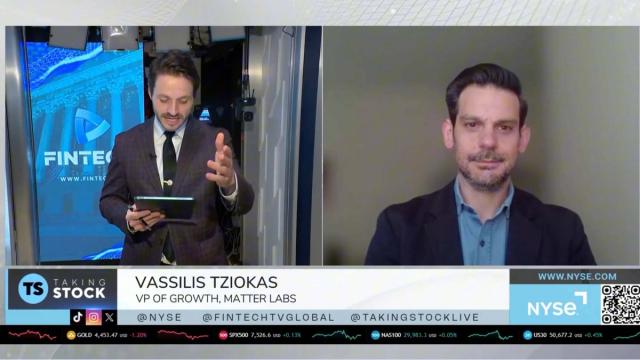
VideoWhy privacy is the key to bringing banks onchain | Vassilis Tziokas, Taking Stock NYSE
Vassilis Tziokas, VP of Growth at Matter Labs (ZKsync), joins Taking Stock live from the New York Stock Exchange to explain why privacy has been the primary blocker for institutional blockchain adoption, how Prividium gives banks a private, compliant, and interoperable environment to move onchain, and where tokenized deposits fit alongside stablecoins — including Matter Labs' partnership with the Cari Network and five U.S. regional banks.
May 28, 2026