


Published May 28, 2026
Why privacy is the key to bringing banks onchain | Vassilis Tziokas, Taking Stock NYSE
Transcript
JD: Welcome back to the show. You're watching Taking Stock, live from the trading floor of the New York Stock Exchange. Vassilis Tziokas joins us now. He is the VP of Growth at Matter Labs. Vassilis, nice to see you here today. Public blockchains is what I want to talk to you about. They create some major concerns around the conversation of customer data. Why has privacy been the one thing blocking banks from going on-chain?
Vassilis Tziokas: Hi JD, and thank you very much for having me today. I think your comment is spot on. What we have witnessed in the market the past years is that a major blocker for financial institutions and enterprises to come and build on-chain is actually the lack of privacy. I want to use a very powerful and simple analogy — the same way that people don't have access today to all the operations and books and businesses of the JPMorgans and all the other major banks today, why should they be able to see their on-chain transactions? So this has been a blocker, but the good news is that this is being addressed by the evolution of technology. We at Matter Labs — we are the company behind ZKsync — we're using a very powerful technology called zero-knowledge proofs. The way it works is pretty much magic: you can verify that a transaction happened without revealing its actual content. So that's the main concept and the main offering we are providing to the institutions ourselves.
JD: Vassilis, you've introduced Prividium as a privacy-focused blockchain product. Let me ask you a little bit more about it. What is it, for people a bit unfamiliar, and why do you think every major bank in the United States should be paying attention?
Vassilis Tziokas: Yes, absolutely. So to make it very simple for everyone to be able to follow who is not a crypto-native person — it is a blockchain platform. It is a very sophisticated toolbox that a bank, a major institution, or a government can use to deploy their own chain. And I know that the word blockchain carries a lot of complexity on its own, but we see a future where managing a blockchain will be as easy and as simple as managing a website. So what we do is provide this very powerful platform, this toolbox, that enables institutions to launch their own private, compliant, scalable, and interoperable environment — call it a blockchain, call it an environment, call it a zone — to be able to move on-chain and interact with other chains and zones. That's what Prividium is.
JD: Stablecoins — I'm almost out of time, but quickly if possible — stablecoins have dominated the headlines for years. Where do tokenized bank deposits actually fit into this conversation?
Vassilis Tziokas: Yes. Stablecoins are the poster child of crypto, as they should be. They're an amazing new instrument, mostly for payments. But we see a new trend — we see the trend that pretty much every asset that can be tokenized will be tokenized. We are spearheading the work and the adoption of tokenized deposits. We believe this is another powerful instrument that actually enables and empowers existing banks to move on-chain and guard their turf. We announced a few weeks ago a partnership with the Cari Network, which is a group effort from five U.S. mid-sized regional banks. And the way it works is that tokenized deposits and stablecoins can coexist. They do not conflict with each other. They serve different use cases and different purposes. But it's the path forward of the least resistance for banks to be relevant and compete in the new digital assets economy.
JD: All right, Vassilis. That's all the time we have. VP of Growth at Matter Labs. Great conversation. We'll see you again soon. Folks watching at home, don't go anywhere — a lot more coming up right after this.
Vassilis Tziokas, VP of Growth at Matter Labs (ZKsync), joins Taking Stock live from the New York Stock Exchange to explain why privacy has been the primary blocker for institutional blockchain adoption, how Prividium gives banks a private, compliant, and interoperable environment to move onchain, and where tokenized deposits fit alongside stablecoins — including Matter Labs' partnership with the Cari Network and five U.S. regional banks.

 Video
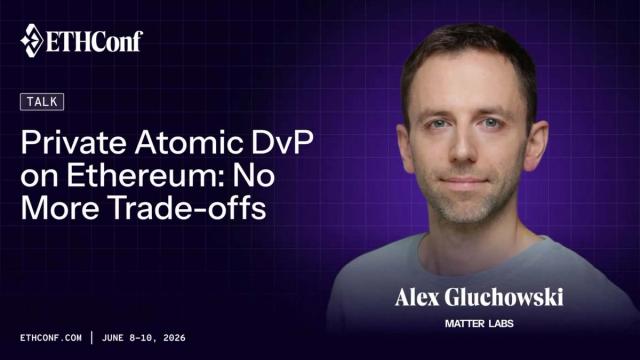
VideoPrivate Atomic DvP on Ethereum: No More Trade-offs
Alex Gluchowski (CEO, Matter Labs) on how Prividium makes atomic delivery-versus-payment possible between private bank zones, settled on Ethereum with cryptographic proof.
Jul 21, 2026

 Video
VideoWhy privacy is bringing institutions onchain. Omar Azhar, The Rollup Privacy Day.
Omar Azhar, Head of Business Development at Matter Labs (ZKsync), joins The Rollup's Privacy Day to explain why institutional adoption has accelerated sharply over the past six months, why privacy is the first gating criterion for banks moving onchain, and how Prividium gives institutions a private, compliant environment to run their own chains — including how private atomic interoperability connects them into bank networks alongside tokenized deposits and stablecoins.
Jun 18, 2026

 Video
VideoCrypto companies try to prove they can grow beyond token trading | CNBC
CNBC examines how Coinbase, Circle, Bullish, Robinhood, and Strategy are shifting from trading-dependent revenue models to financial infrastructure. The video covers Coinbase's "everything exchange" pivot, Bullish's $4.2 billion Equiniti acquisition for tokenized securities, Circle's Arc blockchain, Robinhood's own chain, and why every institution may soon operate a blockchain. A market-wide look at the infrastructure trend driving tokenization adoption.
May 27, 2026