


Published May 8, 2026
Alex Gluchowski: Why ZKsync Is Building Private Infrastructure for Institutions, Not an L2
Transcript
Cami Russo: Okay. We are live. Welcome again. We are live at Consensus in Miami. We have Alex here with ZKsync. And of course, I'm Cami Russo with The Defiant. So, Alex, let's start with — how's your Consensus going? What are the biggest themes you're seeing?
Alex Gluchowski: It's going pretty well. The institutional theme is dominating the venue. Clearly every second stand you see is in black and white colors. It's almost hilarious. Everyone is kind of converging on the exact same style, exact same format of presentation. But I think it signals that this is the direction where we're going.
Cami Russo: Is that bittersweet for you, or exciting?
Alex Gluchowski: For me, it's exciting because I think if you went back to Ethereum conferences, I don't know, eight years ago, it was all unicorns and buffycorns and plush toys. Very, you know, childish. And then a couple of years ago, it would be a lot of kind of gaming-like environment.
Cami Russo: Yeah. You're going through the stages of childhood, teenage ages, adolescence, and now we're kind of at the job fair. With suits. And I allow myself today to wear a t-shirt, but I'm also quite often here.
Alex Gluchowski: I don't think I've ever seen you in a suit.
Cami Russo: I was in a suit! Okay. Yes. But yeah, I think that's been just like the general comment — how many suits there are in Consensus. And yeah, the industry has definitely had to shift into more institutional. Crypto does seem grown up. And we're definitely seeing it here.
So with ZKsync, how are you responding to this? Because it seems like there's this kind of battle between L1 and L2 to attract institutions to build on their network. So what's your pitch?
Alex Gluchowski: I don't think the distinction of L1 and L2 really matters in the institutional space. It's a completely different plane. We're building products that solve problems for regulated finance, and for these big companies that are figuring out how they're going to get on chain. What matters is what product you offer, what properties this product has, and how it solves those problems.
What we're solving is — we are approaching institutions that have been experimenting with blockchain technologies for a while now. And they have some requirements that were just not solvable even a couple of years ago.
Cami Russo: Like which one?
Alex Gluchowski: Banks and any regulated financial institution really has a gating requirement of privacy. Privacy is non-negotiable. You have to have privacy. You cannot disclose your business flows and your customer data to the entire world on chain. This worked for public blockchains and those use cases, but it does not work for bringing the real business workflows on this new rails.
There is a consensus that everyone is moving to digitize and tokenize the assets, but it has to be done with privacy. And now if you are implementing privacy on chain, you really only have like two choices.
Until recently, you could do your isolated environment — on-premises, in the control perimeter of your organization. And this is what banks have done with their private chains. But then you're not connected to anyone. And if you're not connected, there is really a very limited value of what this closed internal blockchain gives you. You really want the connectivity, so you need privacy with connectivity.
And this has been a hard choice. What some people in the industry were trying to sell to all of these institutions now is, "Oh, maybe you're going to have your private environment and you're going to use our connectivity technology to get you out there." But then the problem is that the previous generation of these technologies had fundamental flaws with regard to security and trust assumptions. They would introduce counterparty risk.
And I think two weeks ago there was a ~$300 million hack of a big bridge — the Kelp DAO exploit. This was kind of a wake-up call to a lot of people about counterparty risk. They took it very seriously because when you bridge assets from your blockchain environment, which is controlled and actually cryptographically secured on every transaction, out of it — to a different place, to a different chain, to a different institution you don't trust, or to a public chain — and you use these third-party mediators and facilitators, what you really do is you outsource all of the properties of the bridged assets to this third-party middleman. It's not your security anymore. It's the security of this middleman.
Cami Russo: You're saying the Kelp DAO hack opened people's eyes to the risk of having a private environment, a private blockchain, and using some sort of bridge to connect to public chains. That's a kind of risky solution.
Alex Gluchowski: That just introduces counterparty risk. You have to be willing to accept that. And there is an alternative now, which was not available just a relatively short time ago. You can connect to other participants of the network with full cryptographic guarantees. So you protect all of your transactions with cryptography and you protect all of your connectivity with privacy and with the enforcement of all your rule books, of all the smart contracts, of every single constraint that you want for your assets, for your environment. This is now possible with zero-knowledge proofs. And this is what we're building with ZKsync — we're connecting institutions.
We see a lot of interest — surprisingly more interest in these fundamental security properties than I would expect from, you know, decentralized crypto communities a few years ago.
Cami Russo: So is this proof technology your edge versus, say, Ethereum, versus something like Canton — like private chains? This is kind of the killer use case that you're seeing?
Alex Gluchowski: Yeah. Encryption-protected privacy. Precisely. But it's very interesting because what we're offering is not "oh, come build on our private chain operated by this consortium of these people with some stakes and interests." We offer each institution to take full control over their environment — that they don't depend on anyone. They don't depend on us. They don't depend on Ethereum.
They can use Ethereum as the ultimate settlement and synchronization layer, just because it's a really good place for everyone to use as the settlement layer. But it's not that they are transacting on Ethereum. They are using their own zone, their own institution, and they are connected to other zones, to other institutions who are on their own infrastructure, also on their own terms — using cryptography, using this open-source, cryptographic, zero-knowledge proof–based protocol, plus Ethereum as the synchronization mechanism.
Cami Russo: And is the settlement layer actually Ethereum?
Alex Gluchowski: Yes, but that does not mean that the transactions are on Ethereum. The settlement layer is simply a place where we can all synchronize. We can all agree, "What is the state that I can compare my transactions against?" The ultimate proof that a transaction happened can be traced back to Ethereum.
Cami Russo: Like if there's a hack or something stolen, you can go back to Ethereum and say what the actual state was?
Alex Gluchowski: Yes. It's kind of a pointer. But it could be Ethereum. It could be, you know, a private chain — if a few banks want to do it on a bilateral basis between themselves. It could be something like the New York Times — you could go and publish the hash in the New York Times. It's just that those settlement places would have different security properties and different trust assumptions. Not everyone would trust the New York Times to have the exact same hash correctly posted across all of the issues.
That's why Ethereum is just a natural place where everyone can convene as a credibly neutral, very decentralized, highly resilient location where we can all meet. But it has a very limited role in this setup. The real transactions are happening between the institutions directly, completely privately, not disclosing the information to anyone.
Cami Russo: And why do you think institutions are demanding — so you said privacy is obviously a big one. Is total decentralization, this level of Ethereum-level security, important to them?
Alex Gluchowski: They look at the properties. They don't care about decentralization as an abstract concept, but they care about resilience. They need to make sure that the chain is not going to go down. Ethereum had zero downtime in over ten years. This is valuable. Most chains don't have this. But as a settlement layer, it must be always on. It must be very deeply secured by — you know, you have to have a mindset of defense in depth and security going in all layers of the protocol. And Ethereum has this — with multiple clients, with a lot of battle testing that went into the EVM as a platform and in operation of the chain. So decentralization serves as the means to those ends.
Cami Russo: There's been a bit of a shift in Ethereum — at least Ethereum Foundation strategy — with Vitalik coming out and saying, I guess the subtext was, he was a bit disappointed in the stage of Ethereum L2s. He wished that more Ethereum L2s were at Stage 3 and 4, or you know, beyond having a centralized sequencer and so on. And now it's just leaning into scaling the mainnet. So what's your take there? Is Ethereum becoming more competitive with Ethereum L2s? And what position does—
Alex Gluchowski: Ethereum is definitely competitive with the vision of L2 as it was articulated in Vitalik's rollup-centric roadmap. We are not building an L2. We're building this private institutional infrastructure that is completely separate from Ethereum. We're using Ethereum as a customer of Ethereum because it's the best settlement layer we can use. But that's not kind of L2 in the sense in which it was articulated and lived throughout this vision — that it's going to be the place which extends Ethereum with all of the properties of Ethereum. This is not what institutions need in the way they approach this now.
It's not a public chain. They don't need a public chain. They don't need permissionless. They don't need the ability to exit the system for the users. They're still operating in this permissioned environment. It's somewhat different. They are connected to Ethereum natively. They can interoperate with Ethereum and go and transact and move assets back and forth with full cryptographic security. But that's a very different system.
So yes, if someone is still building L2 as a general-purpose extension of Ethereum in the hope that this will replace Ethereum, this is very wrong. They should not be doing this. It just doesn't make sense.
Cami Russo: Interesting. Okay. So ZKsync is not an Ethereum L2?
Alex Gluchowski: ZKsync is the platform for institutions to go on chain on their own terms, with their own environments. And we're building the network that will help them connect and facilitate transactions. We used to build L2 in the past. This is not where we landed now, and this is not where Ethereum landed.
Cami Russo: Interesting. Okay. What's the trade-off? By using ZKsync — I mean, everything, you know, it can't all just be for free, that you get all this privacy. Is it — are transactions more expensive? They're slower? Like, what's the state of things for this tech?
Alex Gluchowski: You get privacy by running the data completely in your environment with true privacy. The only way to have true privacy is by not actually having your private data leave the perimeter of your control. If you let it migrate away — if you give your data to someone and they promise to keep it private — it's not privacy, it's confidentiality with contractual agreements.
So you get that by using zero-knowledge proofs. Every transaction — and zero-knowledge proofs have evolved incredibly fast over the last couple of years. We've made orders of magnitude improvement in the performance of the systems, and the cost went down to fractions of a cent.
The trade-offs are in a different plane. What we're building is suitable for organizations who want to run their own zones and want to have control over that zone so that they can fulfill their compliance obligations. They can do programmability with full EVM backing, with full flexibility and expressivity of Solidity and other EVM languages.
But it's not necessarily this cypherpunk-level privacy where each user is fully sovereign and autonomous, and they can do whatever and not disclose data to anyone else — like you have on Zcash. This is not what we're building. So it just suits a different type of customer.
Cami Russo: I see. Are there any use cases that you would say are not suited for this ecosystem?
Alex Gluchowski: Probably — we're building the generic infrastructure layer for banks, for financial institutions who are tokenizing all of their assets, infrastructure, and workflows. And it's very clear that within two to five years from now, every bank will be on chain. They will all be connected.
We're building this original vision of — I believe — Satoshi: to have the financial system in the form of the internet of value, where everything can talk to everything else. And the value is expressed programmatically so you can enforce rules. You can encode your rule book in a way that is automatically checked and cannot be violated.
This is what's happening. So we're offering this as an EVM environment.
Cami Russo: To wrap up — are there any announcements that you're making at Consensus? Any new banks coming to ZKsync? Or overall, what are you looking to get out of Consensus?
Alex Gluchowski: Look, we're not making any announcements just yet, but there are a number of really exciting things coming soon for the ecosystem. I'm looking to get out of here and help the space move faster to mainstream adoption. I think this is going to happen.
After the shift that we experienced going from consumer crypto to institutional crypto, it's going to happen a lot faster — especially if the CLARITY Act will pass. And all of these experiments that we see now will come to fruition, probably this year. And we'll see an explosion.
What I see as sentiment is a lot of optimism, a lot of enthusiasm. Everyone is excited. Everyone is just looking at what they should do — there is this sense of urgency and pressure to actually deliver. And that is coming from the established industries, from traditional finance. And this is very exciting.
Cami Russo: It's the most optimistic bear market I've seen.
Alex Gluchowski: Yeah.
Cami Russo: All right. Alex, thank you so much for joining me. And for those tuning in, we'll be right back in just two minutes. So stay tuned.
ZKsync CEO Alex Gluchowski explains why the company pivoted from L2 to private institutional infrastructure, using ZK proofs to connect banks with true privacy

 Video
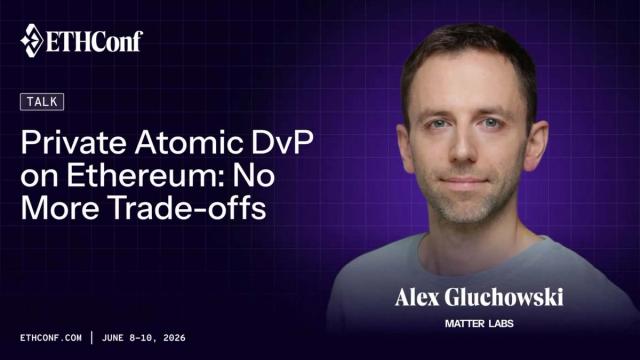
VideoPrivate Atomic DvP on Ethereum: No More Trade-offs
Alex Gluchowski (CEO, Matter Labs) on how Prividium makes atomic delivery-versus-payment possible between private bank zones, settled on Ethereum with cryptographic proof.
Jul 21, 2026

 Video
VideoWhy privacy is bringing institutions onchain. Omar Azhar, The Rollup Privacy Day.
Omar Azhar, Head of Business Development at Matter Labs (ZKsync), joins The Rollup's Privacy Day to explain why institutional adoption has accelerated sharply over the past six months, why privacy is the first gating criterion for banks moving onchain, and how Prividium gives institutions a private, compliant environment to run their own chains — including how private atomic interoperability connects them into bank networks alongside tokenized deposits and stablecoins.
Jun 18, 2026

 Video
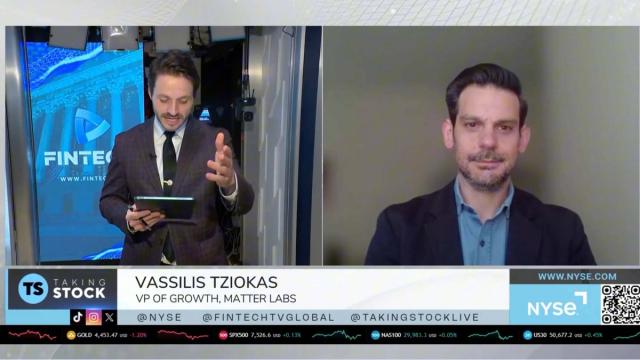
VideoWhy privacy is the key to bringing banks onchain | Vassilis Tziokas, Taking Stock NYSE
Vassilis Tziokas, VP of Growth at Matter Labs (ZKsync), joins Taking Stock live from the New York Stock Exchange to explain why privacy has been the primary blocker for institutional blockchain adoption, how Prividium gives banks a private, compliant, and interoperable environment to move onchain, and where tokenized deposits fit alongside stablecoins — including Matter Labs' partnership with the Cari Network and five U.S. regional banks.
May 28, 2026