


Published Mar 19, 2026
Tokenized deposits mark a new era for American banking | Alex Gluchowski & Gene Ludwin, DC Blockchain Summit
Transcript
Now I have everything needed. Here's the corrected transcript with "Unknown" removed and all names fixed:
00:00:01:06 - 00:00:37:13 Our next discussion focuses on how financial deposits themselves may evolve in a blockchain-enabled economy. Please welcome Alex Gluchowski, co-founder and CEO of Matter Labs, and Eugene A. Ludwig, founder and CEO of Cari Network. Moderated by Jacqueline Melnyk, founder and CEO of Token Relations.
00:00:37:15 - 00:00:58:02 Jacqueline: Hello, everyone. You're seeing déjà vu — I was up here like an hour ago. For the dedicated people sitting in this room, I'm excited to sit down with Alex and Eugene to start off. There was some new news that came out yesterday that Cari Network is building a bank-grade tokenized deposit network on Matter Labs' Prividium, which is a privacy-focused blockchain infrastructure.
00:00:58:07 - 00:01:34:18 Jacqueline: Before we get into all of that, I'd love to know how you two even got together and started doing business.
Eugene: Well, from our perspective, Matter Labs and what Alex has been doing is the highest quality and safest, most risk-focused. And for a banking network, we're interested in the best security, safety, soundness, and compliance. So we were looking around for a blockchain provider that was at the top of the heap — doing all of those things, and yet at the same time was tech-forward and doing all kinds of other things. Alex will tell you about that today.
00:01:34:21 - 00:02:02:12 Alex: Yeah. And from our side, we have been speaking to banks now for over two years since the change in the administration and the pro-crypto friendliness. And Cari stood out as a project that actually connected multiple banks. So all the previous attempts we've seen were isolated attempts to bring and embrace crypto infrastructure for an individual bank.
00:02:02:14 - 00:02:31:27 Alex: But really, a network is only as valuable as the number of nodes — and Cari bringing immediately five banks together, with more inbound, is a big milestone for the industry. And once we saw the vision, we welcomed the opportunity to help here.
Jacqueline: I think maybe at a high level for the audience — why is it important to build a bank-governed tokenized deposit network, especially today in the climate that we're in?
00:02:32:00 - 00:02:57:23 Eugene: You know, Jackie, this is absolutely critical for the banking system and for our business community all over the United States. Well, digital deposits — really interesting. I was asked to study this when I was Comptroller of the Currency way back in 1996. It was clearly coming. Secretary Rubin understood that — the only thing we knew at the time was it wasn't going to come right away.
00:02:57:26 - 00:03:38:19 Eugene: The digitalization of currency is just another step along the trail — from rocks in Mesopotamia and clay tablets, to precious metals, to paper. And now, in a digital world, it's digitalization. For the banks to continue to be relevant and serve customers in every city, it's absolutely essential that they are leaders, not just participants, in this digital transformation. Because this allows people to have 24/7 execution — instantaneous management of their own small businesses, which they couldn't do before.
00:03:38:21 - 00:04:10:21 Eugene: Which will make these businesses more viable. And it's so important to have a network because this shouldn't be just about the biggest guys. I like banks whether the biggest or the smallest, but this has got to be about everybody, because we've got a big country to serve — communities all over the United States. And that's what the Cari Network is all about: serving the big and the small, and giving low and moderate income people, as well as the richest people, an opportunity to build their businesses at the forefront of technology.
00:04:10:24 - 00:04:28:15 Jacqueline: Yeah. When I was planning for this panel, I actually saw that the Mid-Size Bank Coalition of America endorsed Cari's approach, which was interesting to me. And Cari is set for the release of the MVP — Minimum Viable Product — at the end of March, then a pilot program in the third quarter, and then it's fully expected to be out in the fourth quarter. So do you kind of see this network initially appealing to more mid-sized banks than the really big, well-established ones? And if so, why?
00:04:28:15 - 00:05:22:00 Eugene: So the network is for all banks — there's no doubt. For the smaller institutions, a network opportunity is essential because they'll have one or two business customers that trade with each other, but typically not a whole bunch. Huge institutions will often have business customers that trade with each other — so it's critical for them too. But for all institutions, for all banks, to have a bank-centric, safe, trusted way to do this activity is essential. It's all about trust. So the Cari Network is for institutions of all sizes — but it is most essential, and fits enormously, for the smaller end of the marketplace.
00:05:22:03 - 00:05:43:01 Jacqueline: What comes to mind for me is interoperability across all of these different aspects and components — and obviously on your side, Alex, that is probably a very big theme. So how do you think about that in terms of this integration?
00:05:43:01 - 00:06:08:08 Alex: So I want to come back to what Eugene said before — the history of financial institutions and money is the history of trust. It's how do we construct civilizational-level economic cooperation in a way where people who have not met each other, from opposite sides of the country or in different countries, can trust that a transaction is going to be executed correctly.
00:06:08:11 - 00:06:45:02 Alex: And it starts with the institutions. But now, today with blockchain, the real innovation is the automation of trust using cryptography. Now this only works in specific configurations — with public chains and, as is now being done with Cari, by using Prividium. This gives each individual bank their own private Prividium that enables them to do what they want under the control mandated by regulators.
00:06:45:04 - 00:07:09:02 Alex: But they are all connected to Ethereum. They're using Ethereum as the open standard for synchronization and settlement. And this enables every bank to connect to each other. The banks that own the Cari Network, the banks that are directly building on Ethereum, and the banks that will be using Prividiums to build their own private networks on Ethereum — can all interoperate, because blockchains provide this shared open standard. This is very, very valuable.
00:07:09:02 - 00:07:33:01 Eugene: Well, two things you had mentioned, Jackie, I think bear emphasis. One — we're deeply honored by the Mid-Size Bank Coalition endorsement. That's a big deal because this is a group of highly qualified executives who are really thoughtful about what they endorse. And I think the reason they did it is because what we're building is the first bank-standard digital network — where customers will be totally safe, with the highest-quality compliance, safety, and soundness tools.
00:07:33:01 - 00:08:00:05 Eugene: And that's one of the reasons we wanted to work with Matter Labs — because this is a bank-standard, safe way to really do their businesses and enter the 21st century with the flags flying.
Jacqueline: And do you think this is going to ultimately rival traditional stablecoins?
00:08:00:05 - 00:08:23:26 Eugene: I think they can all exist together. They're different technologies, different approaches for different purposes. And I think that's what we're going to see.
00:08:23:29 - 00:08:56:25 Eugene: You know, Alex is really an expert in this area. I know a little bit about banking. But what we're going to see, I think, is a variety of different solutions that solve different problems. But for those customers who need safety and security — and the banks that need to live in an ecosystem of safety and security — this network approach that we're jointly engaged in seems to me the most prudent way to do it.
00:08:56:28 - 00:09:24:08 Alex: I fully agree. Tokenized deposits have all of the properties of traditional deposits. They're insured. They're guaranteed by the bank. They run within the secure perimeter of the banking protection systems. But the banks are not precluded from also using stablecoins if they're willing to expand — and they can be using them on the same infrastructure. They can be connecting to other public crypto markets using stablecoins in combination with tokenized deposits.
00:09:24:08 - 00:09:57:21 Alex: So it's a different instrument — all at their disposal as a tool to integrate. But for banking purposes, tokenized deposits is the actual immediate value-adding mechanism they get from blockchains — because they can move from the infamous T+1, T+2, T+5 days directly to T+ seconds. Move at the speed of the digital economy, on the internet.
00:09:57:24 - 00:10:22:02 Alex: And this is only possible with cryptographic protection of trust. Because if transactions happen irreversibly within seconds, there are no humans in between who can intervene and serve as circuit breakers. You really need incorruptible financial infrastructure that guarantees the correctness of all of these transactions.
Jacqueline: And just think of a small business —
00:10:22:05 - 00:10:45:14 Eugene: You've started a business, and for many small businesses, they need instantaneous and secure transfer of wealth from what they buy to what they sell. And the more they're able to really know what their balance sheet looks like, the more they can avoid being taken advantage of when the check just doesn't arrive and they can't pay for the goods.
00:10:45:19 - 00:11:06:18 Eugene: So for a small business, this is essential. Its members don't have hundreds of people running around — they've got to do things late at night or early in the morning. And the 24/7 opportunity is critical. And often these small businesses are serviced by banks that are not the largest in the land — banks of all sizes, often in their communities. And this will allow those businesses and those banks to really participate in this important transformation.
00:11:06:26 - 00:11:46:19 Jacqueline: Yeah, I agree with that. I was talking about this yesterday — the T+1, T+2, T+5 settlement times. And at the very least, if people are going to be cautious about entering the space, they could understand that speed is at least a positive, and they want that — instantly. And the existing infrastructure really doesn't provide for that. So do you see the future of payments and blockchain technology really reshaping the way that banks and even small startups integrate with these things?
Eugene: Absolutely, absolutely. This is a transformational moment.
00:11:46:21 - 00:12:25:04 Eugene: And it's a wonderful thing. As currency has gone from rocks in Mesopotamia and clay tablets, to precious metals, to paper — this is a transformation that transforms not only how people make payments and do their business, but also offers them opportunities they've never had. Because smart contracts can be attached to these, so that they can not only secure instantaneous payment, but have conditions on when a payment is made — which will really help make them safer and actually run their businesses better.
00:12:25:06 - 00:12:55:08 Eugene: So this is a transformational moment. Programmable money — which this allows — is something that's never existed before in this kind of environment, and is now becoming available to banks within their regulated sandboxes. Because the pressure from the open crypto economy has been very significant, with stablecoins obviously taking a lot of money out of the banks. And in this case, there's systemic pressure for the banks to adopt.
00:12:55:13 - 00:13:17:12 Eugene: The fractional deposits that come into the banks — those deposits are available to make loans and support the economy of the United States. That's why this is such an important part of the overall digital ecosystem. If everything were to go out of the banks, there's just not the infrastructure to support loans and basically build an economy.
00:13:17:15 - 00:13:47:20 Jacqueline: To that point — do you think this is alleviating the current tension between crypto companies and the stablecoin yield issue and banks on the GENIUS Act?
Eugene: I would hope so. I think this is a time when there shouldn't be conflict. There's got to be an opportunity for working together. And that's what I love about the interoperability nature of what Matter Labs and Prividium are building here — because there will be those customers that want to speculate, those that want tokenized securities, and those that want to operate their own lives in different ways. And this will give them that opportunity in a safe and digital environment.
00:14:21:06 - 00:14:43:23 Jacqueline: And lastly, with all of this in mind — how would you describe the shift coming, looking forward, when we think about traditional financial infrastructure, tokenized deposits, and everything that both of your companies are working on?
Alex: I think what we are seeing is, really for the first time, the implementation of crypto's original promise: to build the Internet of Value that is all connected. Previously we had several separate networks — the network of banks, the trading companies, the emerging crypto networks. Now for the first time, they are connecting.
00:14:43:23 - 00:15:10:23 Alex: So if stablecoins are just one transaction away from traditional banks' tokenized deposits, that enables truly seamless movement of money across the entire economy. That's great for the economy, that's great for crypto, and that's great for banks — because they are now being elevated from the era of 1970s COBOL-based mainframes, leapfrogging directly into the future.
00:15:10:25 - 00:15:32:25 Eugene: And making this safe is absolutely essential. In one sense, this isn't really so remarkable. If you have a deposit, you often have a checking account — you write a check, you transfer the check, and it gets changed into an account at another institution. This is just a tokenized check. It's a digital check. It's a virtual check, in a sense.
00:15:32:28 - 00:16:15:14 Eugene: And what it does do is allow people to utilize this important technology and be safe within the confines of regulated institutions that care about privacy — by law: privacy, fair lending, fair treatment, anti-money laundering. The banks will have their own anti-money laundering systems, and now be putting other protections on top, so that people can participate in this environment for smaller and critical activities in a safe and sound fashion. And it ties the whole digital infrastructure together.
00:16:15:14 - 00:16:37:13 Jacqueline: Yeah, I'm excited to see how it all pans out. Congrats to you both, and thank you for your time. And thank you to everyone for listening in.
Alex Gluchowski, co-founder and CEO of Matter Labs, joins Eugene A. Ludwig, founder and CEO of Cari Network, for a panel discussion moderated by Jacqueline Melnyk at the DC Summit. The conversation centers on Cari Network's announcement of a bank-grade tokenized deposit network built on ZKsync's Prividium — bringing together five major U.S. regional banks including Huntington Bancshares, First Horizon, M&T Bank, KeyCorp, and Old National Bancorp. Alex and Eugene explain how Prividium solves the longstanding tension between banks' need for privacy and compliance and the speed and composability that blockchain enables — allowing institutions to move from T+2 settlement to T+ seconds while keeping deposits FDIC-insured and on bank balance sheets. Together they make the case that tokenized deposits and stablecoins are complementary, not competitive, and that this moment represents the first real implementation of crypto's original promise: a fully connected Internet of Value.

 Video
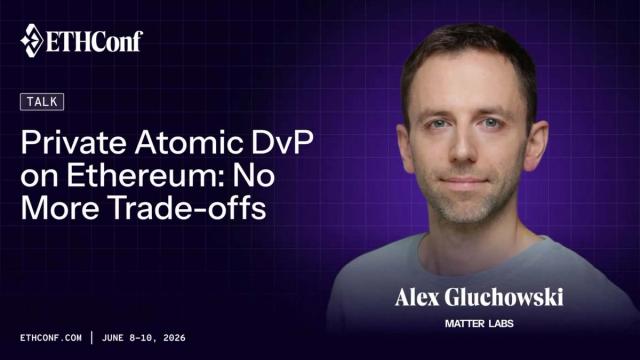
VideoPrivate Atomic DvP on Ethereum: No More Trade-offs
Alex Gluchowski (CEO, Matter Labs) on how Prividium makes atomic delivery-versus-payment possible between private bank zones, settled on Ethereum with cryptographic proof.
Jul 21, 2026

 Video
VideoWhy privacy is bringing institutions onchain. Omar Azhar, The Rollup Privacy Day.
Omar Azhar, Head of Business Development at Matter Labs (ZKsync), joins The Rollup's Privacy Day to explain why institutional adoption has accelerated sharply over the past six months, why privacy is the first gating criterion for banks moving onchain, and how Prividium gives institutions a private, compliant environment to run their own chains — including how private atomic interoperability connects them into bank networks alongside tokenized deposits and stablecoins.
Jun 18, 2026

 Video
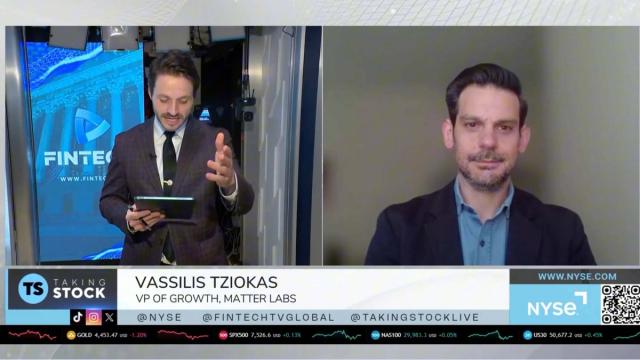
VideoWhy privacy is the key to bringing banks onchain | Vassilis Tziokas, Taking Stock NYSE
Vassilis Tziokas, VP of Growth at Matter Labs (ZKsync), joins Taking Stock live from the New York Stock Exchange to explain why privacy has been the primary blocker for institutional blockchain adoption, how Prividium gives banks a private, compliant, and interoperable environment to move onchain, and where tokenized deposits fit alongside stablecoins — including Matter Labs' partnership with the Cari Network and five U.S. regional banks.
May 28, 2026