


Published Mar 19, 2026
Why five U.S. banks with $600B in deposits are moving to ZKsync | Alex Gluchowski, The Rollup
Transcript
Here is the fully corrected transcript:
00:00:00:00 - 00:00:23:02 Host: Today we have the inventor unpacking the launch of the Cari Network, powered by some of the most influential folks in the banking industry in the United States of America, specifically the Comptroller of the Currency. Alex, great to have you back on The Rollup, man.
Alex: Thank you. Excited to be here.
Host: Yes, welcome to DC. I assume it's not your first time considering all the work that's been going in since launch.
00:00:23:03 - 00:00:54:06 Host: Let's not bury the lead here. We were once fighting the banks. The banks are now being onboarded. They want privacy. They want block space, and they want to operate distributed ledger technology. Why? What is the demand side of this and what's going on here?
Alex: Above all else, they want to be modern. They want to go from this era of the 1970s in which they got stuck for many decades, and finally want to move with the markets — which are real time, progressing in seconds. And we have these T+1, T+2, T+5 settlement delays, which are absolutely ridiculous.
00:00:54:06 - 00:01:27:26 Alex: They cannot continue the way they go now. But the reason this has perpetuated for so long is that the banks have been caught between two conflicting requirements. The regulations on the one hand demanded that they preserve control — control over privacy, over the private data of the banks — with the Bank Secrecy Act and business logic.
00:01:27:28 - 00:01:55:18 Alex: Protection of basic common-sense privacy. Data of the customers. On the other hand, they have felt the pressure that they need to connect to others much faster than what was possible before. And this pressure is now materializing in stablecoins taking so much value away from the banking system — from deposits — into these completely new rails.
00:01:55:18 - 00:02:33:16 Alex: And the banks, of course, feel this pressure. And it was not possible to reconcile until the arrival of Prividium and zero-knowledge cryptography. So to understand why — we really want to zoom out and look at the history of banking as a whole. For millennia and centuries now, it's been a history of trust. It's been a question of how to build trust structures that enable people to transact on a civilizational level with other folks who they don't know, who are living in different places, in different countries, governed by different laws.
00:02:33:16 - 00:03:03:21 Alex: And it's been this history of creating trust structures — of organizations and institutions that connect to other people and other institutions they can trust. And the problem is this does not translate into the internet era. Because in the era of the internet, we transact in seconds. There is simply no buffer, no circuit breakers where humans can intervene and perform human-based trust-building functions.
00:03:03:23 - 00:03:30:16 Alex: You really need something that protects the integrity of these transactions by design — with mathematical guarantees, with computational guarantees. And this is, of course, what Bitcoin, Ethereum, and the blockchain world brings to the table: incorruptible guarantees of transaction integrity. But this was not compatible with privacy — and zero-knowledge proofs gave us that change. And Prividium is the answer to this.
00:03:30:18 - 00:03:54:18 Host: Beautiful. And so in this Cari Network, this network is actually able to keep the banks' deposits on their own balance sheet with FDIC coverage, but having it on-chain. How does that work? And how is that different from stablecoins? Because Omar from your team came on the show and was talking about tokenized deposits — he was alluding to this, but I think there's still a lot of misconceptions. What is the difference between tokenized deposits like this and stablecoins?
00:03:54:24 - 00:04:36:09 Alex: This is a fantastic question. And on the technical level, there is indeed very little difference. Both are governed by the same ERC token standard. And you can think of tokenized deposits essentially as bank-issued stablecoins that are issued on their rails and within the perimeter of the banking infrastructure that they control — to essentially the same degree as they control the deposits — with the difference that this is now a payment instrument that is compatible with blockchain rails.
00:04:36:11 - 00:05:00:05 Alex: So you can apply all of the same logic. It's not just a record in a database that sits there and can only be moved by the bank. It's not something you as a user can only control through traditional means. This is something you can use on smart contracts. You can do repo, you can do borrowing and lending.
00:05:00:08 - 00:05:22:28 Alex: You can do more complex structures and integrate this eventually with derivatives and financial trading. You can also combine it with stablecoins. Some of the banks will be moving faster than others — we've seen this with Arab Bank, for example. They are stablecoin-native from day one. Some of the other banks will not be as aggressive, but they will all be living on the same network.
00:05:22:29 - 00:05:45:21 Alex: So now with tokenized deposits being issued as part of the ZKsync network, they will be compatible. We have other ecosystem players building clearinghouses that will enable banks to connect to each other — but will also enable them to connect to the world of native crypto stablecoins and also capital markets.
00:05:45:21 - 00:06:30:14 Alex: All on Ethereum itself. Because what Cari is building with Prividium is settling on Ethereum. This is a really interesting thing to talk about. The banks understand that when they are figuring out all the rails and how they can connect to each other, the only standard that can win is an open standard. We've seen a number of competing private consortium networks — some driven by the banks, some created by alternative commercial companies trying to fill this niche and say, "we will be the payment rails, we will be the place where everyone connects." And all of them are saying the same thing.
00:06:30:14 - 00:06:55:12 Alex: But the reality is none of them can fulfill this. The only true alternative is real open source, fully permissionless networks. And I think Ethereum has by now won this category — as the global settlement layer for all world finance. And it's the only natural place where everyone can agree to build on, because everyone understands that it's the only place that will not be permanently captured or heavily controlled by their competitors.
00:06:55:15 - 00:07:27:20 Host: Yeah. I want to get your read on a couple of things. We here accept that Ethereum is the open standard and has the most potential to be the standard when it comes to open finance and settlement. I've also said on the show recently that we have the New York Stock Exchange launching its own network for tokenized equities, the Dow Jones, the Nasdaq. We have this new L1 trade invention that is coming out. We also have things like Tempo that launched today.
00:07:27:22 - 00:07:49:17 Host: How much credence do you give to these new networks that are seemingly launching with the same principles in mind — tokenization, equities, high-quality assets? Do you think eventually they will pivot to Ethereum and become interoperable, either as a rollup or by moving their business onto Ethereum? If so, why?
00:07:49:19 - 00:08:17:14 Alex: Look, this is a natural process. Blockchain as a technology is a superior way to manage value. So even if you are deploying something for a single organization, blockchain is a better database because it's incorruptible by design. You cannot modify it by a single system administrator. You can split control. You can do a lot of interesting things. You can add programmability of smart contracts even within a single organization.
00:08:17:17 - 00:08:40:26 Alex: So it's very natural that each organization will have their own blockchain system. They must have something that is completely under their control, but inherits all of the benefits of blockchain. Now the question becomes — how do you connect them all together?
00:08:41:03 - 00:09:07:18 Alex: So the fact that all of them want to build their own blockchains is really the underlying thesis of Prividium. We come with this open source technology and say, hey, you want to build — you need privacy, you need integrity from blockchain — you can take this framework and build your own system. Now, as a bonus on top of that, you can be connected to Ethereum.
00:09:07:20 - 00:09:25:18 Alex: And everyone else is on Ethereum. And with ZK proofs you also get private interop. And this is very, very important. This is very important for banks because they cannot allow the visibility of inflows and outflows — specifically for tokenized deposits — to happen on public networks. Regulators have already flagged this as a risk for triggering bank runs and things like that.
00:09:25:18 - 00:09:49:15 Alex: Right. So now other organizations — like the ones you mentioned — are going to be building their own networks. Dawn is a venture by Stripe. So obviously Stripe is a large payment processor that wants to have their own network, and they don't care if it's an L1 or L2. They're going to build that one. And of course, all of them will try to get everyone else onto their network.
00:09:49:15 - 00:10:29:13 Alex: But that's precisely the reason why it's never going to happen in the end. Stripe wants everything to happen on Dawn. But JP Morgan wants everything to happen on JP Morgan chain. And Circle wants everything to happen on Base. And so on and so forth. They will never agree. The large players will never agree to build on the infrastructure of another large player. And this is why Ethereum is the only option — the only way forward as a neutral infrastructure that everyone can agree on as the place where all of the connections are built.
00:10:29:15 - 00:11:04:03 Host: With this in mind, Alex, coming back to the launch of Cari and kind of this 2026 rollout — you have some big banks involved here in DC, in New York, in the States. M&T Bank, KeyCorp, Huntington — some of the names here. What is going to be the first use case that they're doing on the network? What are some of the experiments or tests that they've been running? And what does that spectrum of use cases look like as they get more and more comfortable using blockchain?
00:11:04:06 - 00:11:23:12 Host: What is going to be the first use case that they're doing on the network? What are some of the experiments or tests that they've been running? And kind of what is that spectrum of use cases as they get more and more comfortable using blockchain for their company?
00:11:23:14 - 00:11:46:25 Alex: Yeah. These five banks you mentioned is just the beginning. I just spoke to Eugene A. Ludwig, the founder and CEO of Cari, yesterday. He said that immediately after the announcement, he got more inbound from other banks who want to join. From now, it's going to expand very fast. Now, the very first use case for these banks is very simple.
00:11:46:27 - 00:12:14:28 Alex: It's just replacing ACH with a real-time means to connect the banks. So according to some estimates I've seen — and I can't vouch for 100% validity of them, but it probably goes in this direction — around $27 trillion sits in nostro accounts on the correspondent banking rails, completely idle, just because the banks need a way to connect to each other.
00:12:14:28 - 00:12:35:05 Alex: And you cannot build a relationship matrix of every bank to every other bank in the world. That would be tens of thousands of banks with millions of connections — that does not work. So they can connect only to some banks they know and trust, put money there, and from there connect to others. And they have to rebalance and reconcile.
00:12:35:12 - 00:13:10:01 Alex: And this is all not happening in real time. And this is causing this massive friction of idle capital. The cost is quantifiable and enormous. A single organization that has finances split between different financial endpoints — let's say a mid-sized corporation with $3 billion in assets — has roughly $30–50 million every year lost on this friction in missed interest payments on treasuries and missed opportunities on using this capital in more productive ways.
00:13:10:04 - 00:13:32:16 Alex: All of that is going to be unlocked. So this is the very first use case — but that's of course just the entry point for everything else you will build on top once you have the deposits tokenized. Because now it's easy to expand into all the other use cases of crypto: repo, tokenizing equities, tokenizing everything else.
00:13:32:19 - 00:14:08:06 Alex: But once you have the foundation — the tokenization engine, the dashboards, user controls — which is a very important large part of Prividium — it's important to say that Prividium does not come as an empty computer. It's not just empty infrastructure that you have to build applications on. It comes with tools for treasury managers, for CFOs, for compliance officers — to monitor the network, to configure exactly who has access, who may see transactions, who may transact, who may modify specific contracts.
00:14:08:09 - 00:14:31:27 Alex: Some of the contracts are public but with specific guardrails. And you can easily fine-tune all of that. Once you have these basics in place, all the other applications become like 5% of the effort that you needed to get to invoice.
Host: So now that we have Prividium, and we can tweak all these dials — we've also got tremendous regulatory momentum. The SEC, the CFTC partnering on digital commodities and digital tools. I've said — and I'll push back on this a little — that policy is really where a lot of the innovation is happening.
00:14:32:00 - 00:14:53:27 Host: You were here in 2020, 2021 — even before that — inventing these things, building out the technology, building the architecture of these chains. Do you see most of the technical work as complete and production-ready for institutions? Is it now about onboarding the institutions, educating them, selling them on these things, helping them understand the benefits? Or do we still have more technical work to go?
00:14:54:00 - 00:15:17:11 Alex: I will always have more technical work to do. At what point was Amazon complete and great? Like, you get to a point — it's an evolving organism, an ecosystem with various parts of technology being constantly developed. But I would say that we have the absolute basics in place for institutions to actually start transitioning to blockchain rails in a compliant way.
00:15:17:11 - 00:15:42:00 Alex: I mean, you could do it before — you could do some compliant finance on public chains, and we've seen that being done with some of the big banks tokenizing and going on Ethereum. But it was not there with privacy. And I believe Cari is the first ever project that has more than one bank on the network.
00:15:42:02 - 00:16:06:03 Alex: Yeah, this is critical. Having a single bank doing some experiments — like all the banks have innovation departments, they just do pilots, they just do things. And it sounds impressive, but it's not going anywhere. Cari is actually solving a real big problem with a lot of money on the prize for that.
00:16:06:03 - 00:16:27:18 Alex: The reason they can do it between different banks is because it's settled on a neutral infrastructure that none of them controls. And Cari itself does not control it — it's really settled on Ethereum and protected by zero-knowledge proofs. The integrity is guaranteed mathematically.
00:16:27:21 - 00:16:55:00 Alex: And to preserve the privacy, they can configure it correctly. The transacting parties only see what is relevant for them and not everything that's happening on the network. This for the first time opens a much larger scope for what's possible on blockchain rails for compliant institutions. And this is, frankly, a much, much larger market — orders of magnitude larger than what was possible before in traditional crypto.
00:16:55:00 - 00:17:20:27 Host: Yeah. I mean, just coming to a close here — when you're thinking about the addressable market for these types of blockchains, how big are we talking? How much asset volume, how many tokenized deposits on the network — how big are you thinking?
Alex: Oh, we just started with five banks. They have north of $600 billion in deposits that they are looking to tokenize. And tokenized deposits in US banks alone is something like around $8 trillion. But that alone — plus, as I mentioned, $27 trillion is the worldwide estimate on the money locked in correspondent banking.
00:17:43:19 - 00:18:09:08 Alex: But if you go beyond that — and this is just the beginning — you really need a single use case to start a complex network working, because it's a very hard chicken-and-egg problem. A network is only as valuable as the participants in the network. So we needed something that provides value from day one, that is immediately valuable even to a single institution or a small group of institutions.
00:18:09:14 - 00:19:20:08 Alex: But once you have that, this is the crystallization point from which the network grows and expands into these trillion-dollar markets. And look — it's always been the promise of blockchains to tokenize everything. Ethereum specifically has always had this Internet of Value vision. Just like what the internet has done to information — every type of information is now on the internet. We're doing this as a kind of radio, video, podcast. Previously you would have had a split between the radio network and the TV network, maybe pictures printed in newspapers. Now everything is digitized on the same rails. The same thing is going to happen with finance.
00:19:20:08 - 00:19:41:20 Alex: All of these isolated lanes and silos will be merged together in one big network. And that's going to happen with blockchain.
00:19:41:26 - 00:20:13:01 Host: Alex, the best thing — for you and for me — how do you grapple with this institutional adoption wave? Banks coming on-chain, tokenized deposits, regulatory action, different rules, different asset classes. As a very aligned person with the core ethos of blockchain — decentralization, immutability, censorship resistance — how do you currently grapple with the state of the industry?
00:20:13:06 - 00:20:45:12 Alex: This is 100% compatible with what we do. Our mission from day one was to advance freedom for the world. Freedom drives progress and prosperity. I was very impressed yesterday when we met with Eugene A. Ludwig, the founder of Cari, at his place — the Ludwig Institute for Shared Prosperity. And we spoke about this: how we really have an aligned vision. Everything that makes the economy more efficient advances economic freedom.
00:20:45:19 - 00:21:21:03 Alex: Everything that makes the traditional financial system more integrity-preserving advances the mission of freedom. Because now you don't rely on trust in people — the more you can automate, the less extraction from individuals can happen. And if you zoom out on the bigger vision — when we integrate banks into the financial rails and connect them to Ethereum, this strengthens the Ethereum ecosystem. This strengthens all of crypto.
00:21:21:03 - 00:21:45:03 Alex: Because now if tokenized deposits are just one transaction away from stablecoins, and one transaction away from native ETH and all of the tokens — you essentially merge both markets together. You have the traditional financial markets and the new crypto-native markets all being traded, all being connected in the same network. That's the bull case for crypto as a whole. And that's the bull case for our mission of advancing freedom.
00:21:45:05 - 00:22:01:08 Host: This is the new financial system and it's playing out right before our eyes. Alex, thanks so much for joining. You've been here the whole journey, so we look forward to the next generation of Ethereum and digital assets as well. Thank you Alex. See you soon.
Alex Gluchowski, co-founder of ZKsync, joins The Rollup live from the DC Blockchain Summit 2026 to unpack the launch of Cari Network — the first-ever tokenized deposit network with multiple U.S. banks on a single blockchain infrastructure. Alex explains why Prividium and zero-knowledge cryptography finally resolve the longstanding tension between banks' need for privacy and their need to connect in real time, unlocking a path from T+2 settlement to T+ seconds. He breaks down how tokenized deposits differ from stablecoins, why Ethereum is the only neutral settlement layer all institutions can agree on, and how the $27 trillion trapped in correspondent banking is just the starting point. With five founding banks holding over $600 billion in deposits and more already inbound, Alex makes the case that this is the crystallization point for crypto's original Internet of Value vision.

 Video
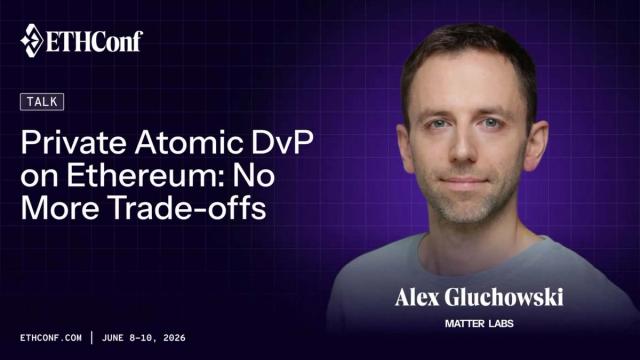
VideoPrivate Atomic DvP on Ethereum: No More Trade-offs
Alex Gluchowski (CEO, Matter Labs) on how Prividium makes atomic delivery-versus-payment possible between private bank zones, settled on Ethereum with cryptographic proof.
Jul 21, 2026

 Video
VideoWhy privacy is bringing institutions onchain. Omar Azhar, The Rollup Privacy Day.
Omar Azhar, Head of Business Development at Matter Labs (ZKsync), joins The Rollup's Privacy Day to explain why institutional adoption has accelerated sharply over the past six months, why privacy is the first gating criterion for banks moving onchain, and how Prividium gives institutions a private, compliant environment to run their own chains — including how private atomic interoperability connects them into bank networks alongside tokenized deposits and stablecoins.
Jun 18, 2026

 Video
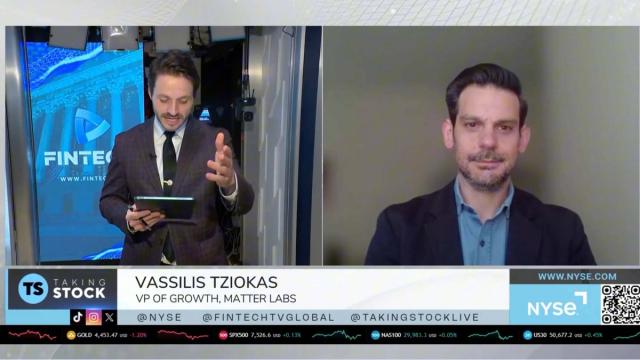
VideoWhy privacy is the key to bringing banks onchain | Vassilis Tziokas, Taking Stock NYSE
Vassilis Tziokas, VP of Growth at Matter Labs (ZKsync), joins Taking Stock live from the New York Stock Exchange to explain why privacy has been the primary blocker for institutional blockchain adoption, how Prividium gives banks a private, compliant, and interoperable environment to move onchain, and where tokenized deposits fit alongside stablecoins — including Matter Labs' partnership with the Cari Network and five U.S. regional banks.
May 28, 2026