


Published Mar 18, 2026
ZKsync brings Institutions onchain | Alex Gluchowski, SmartCon
Transcript
Today we're going to talk about incorruptibility. My name is Alex. I'm the founder and CEO of Metal Labs, where the company behind the K sync, which started seven years ago as the pioneer of zero knowledge proofs on Ethereum with a mission to scale Ethereum and blockchains, preserving their incorruptible properties. And I, we shifted their focus recently much more in institutions.
So for those of you who are maybe not familiar with you, we are the today the largest K ecosystem and one of the leaders in institutional adoption on Ethereum with some of the biggest names in finance building on, on our stack with recent, big names such as Adi, which is project by ICI, Abu Dhabi and the first Bank of Abu Dhabi with fidelity Deutsche Bank, a number of other institutions and a large, RWA ecosystem, with many chains.
But, we started as a crypto native project, and we have initiatives that are focused towards institutions. And the reason for this is, as you all are probably familiar, there is a spirit of change in the air that the financial institutions, banks and enterprises are all feeling. And you probably feel it as well. As I brought this, quote when I was preparing the, the, the deck, but, I could have used a quote from every second keynote or panel at this conference from today and yesterday.
It's very palpable. And the reason for this is in, in our opinion, is institutions are facing what I would call an adopt or die moment. The customer demand that is mounting from their customer base is demanding, 24 over seven settlement, the convenience of the, web2 like, experience that that we are familiar in as consumers and that is still locked away from, from the institutional, players, the legacy systems they have are slow, ineffective.
We still operate with T plus one in many cases T plus two t plus five days. And this is simply not acceptable for enterprise customers for our for retail, for any cross-border or multinational corporations that are operating with real big and institutional money. And the companies that cannot adopt will be just out competed by, by the ones who are more agile.
And blockchain systems offer a natural path forward for institutions to, progress and become modernized. But the blockchain systems have, kind of split into large design categories over the, their evolution over the last couple of years. We have public chains that offer all the core properties of crypto that we know from Bitcoin and Ethereum. The credible neutrality, hard finality, guarantees and connectivity or composability with other protocols.
So the barriers of entry. Hello, everyone can build and connect to each other. But if you are building on public chains, you're compromising control over your systems and over your infrastructure. And this is simply unacceptable to a lot of financial institutions, if not most of them for business reasons. So on the one hand, specifically for privacy reasons, is like one of the largest concerns.
But then also for compliance reasons, they operate in different jurisdictions. Sometimes they have to keep the data on specific servers in that jurisdiction, and they cannot even exchange data between the subsidiaries of the same corporation. So, we have seen a lot of experiments in the last two, three, four years by banks deploying their own private blockchain systems as a way to kind of circumvent these limitations of public chains.
And we you probably all heard the phrase blockchain or bitcoin as a, mode of this movement. And that has not gone anywhere because a private chain that is only living in your systems and not connected to anyone else does not give you much benefits over a mere database. So sure, there is some convenience. You can use some of the industry's best standards on on smart contracts, access control, etc. but that's like that's not a 0 to 1 enablement that there's just some, some improvement.
Because if you have one big consortium chains between multiple different entities, then everyone will run the validator node and everyone will see everything that's happening there. So whereas the privacy benefit that that you're expecting. So this has not worked at all. And what we are doing at GK sync right now is we just introduced a brand new architecture called privilege, which we believe is the best solution to this problem.
And this is the feedback we are getting from a lot of institutional customers that we're counting conversations with. Freedom is the intersection of the private and public blockchain design spaces and what it is. It's essentially a private chain architecture that you can launch and operate on your banking or enterprise infrastructure, as you are familiar with the, with the private chains that that existed before the legacy, private chains like Hyperledger Basil, Hyperledger Fabric, Corda, etc..
But it's a GK chain, so while you preserve full control and sovereignty and full privacy, preserving aspects of it, and you have granular access control, you can settle on Ethereum so you can anchor your chain on the stream using incorruptible ZK cryptography. And this enables you to connect to other private homes and to other public chains, starting with Ethereum.
Or you can tap into the capital pool, of the largest, DeFi, blockchain in the world. And you connect to other private chains with direct connectivity based on ZK, interoperability protocols, meaning you don't need some third party, third trusted third party bridges. You don't need external capital injections. You can just interoperate the way you do today on with Https from one point to another point straight.
And, this is a unique architecture. Like not no, no other technology, but SSC can enable this because what GK really does, it creates the automation of trust. It gives you the incorruptible properties of, the, the compute that blockchain systems are like. They are computers. But they are doing things correctly, like it's impossible for this chains to execute any invalid operation, to violate any contractual logic to, to spend money on behalf of any of your users without authorization of those users, and is guaranteed not by trust in operators of those chains.
It's purely guaranteed by cryptography. And then Ethereum is the ultimate settlement layer that synchronizes these chains between themselves. And this only became possible this year. The ZK proofs have been around for now a very long time. The first roll up we launched on Ethereum was in 2008. By 19, I think that was the very first working ZK roll up ever in existence.
And then we brought the for z KVM a couple of years ago. They were slow and ineffective from the performance perspective. Like you could not around the proofs. You could not generate the proofs on your, corporate premises. You would have to delegate them to the cloud. And this would compromise the privacy aspect. And it was just this year that the ZK technology matured to the point of, us being able to generate proofs for a single transaction down to 0.1 cent, proving cost for something like, stablecoin transfer, we can commit the proofs, for a single block within one second.
So the fool proof generation for a block takes only one second. So we can enable this one second interval between these key chains, which is this holy grail of t0, and we can sustain up to over 15,000 transfer transactions per chain, which satisfies, which is double the average, visa transaction load if you take it annualized. So we are now finally ready with this infrastructure.
And, we just published a white paper in cooperation with Deloitte, with a number of largest institutions in the world participating as observers. We're including several central banks, big US, European, Asian and Middle Eastern banks and and financial organizations. I highly encourage you to just Google as you can sync brevity white paper. You will download the report and you will have a lot more details.
There. And our team is also here. We'll be happy to to talk to you after the, this keynote and, and share more if if you would like to learn about Providence and how they will transform the future of institutional, private, institutional chains that are connected in the, incorruptible new digital economy, on chain. Thank you. You can also use this this QR code to the link.
Alex Gluchowski, founder and CEO of Matter Labs, delivers a keynote on how ZKsync is solving one of blockchain's biggest challenges: bringing institutions on-chain without sacrificing privacy or control. He outlines why existing approaches — public chains, private chains, and consortium chains — have each fallen short for enterprise adoption. ZKsync's new architecture, Prividium, offers a private chain that institutions can run on their own infrastructure while settling on Ethereum via ZK cryptography, enabling trustless interoperability with other chains. With proof generation now down to 0.1 cent per transaction and block finality in under one second, the technology is finally ready for real institutional deployment. The initiative is backed by a white paper co-published with Deloitte, with participation from central banks and major financial institutions worldwide.

 Video
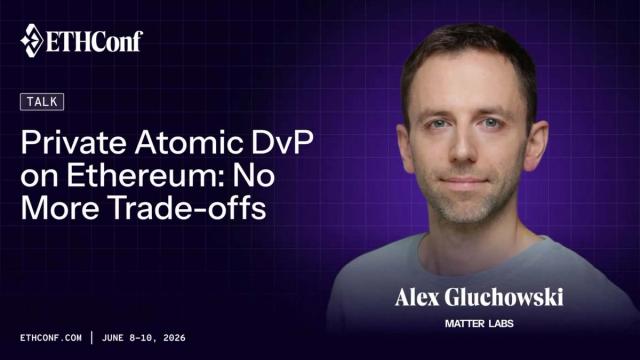
VideoPrivate Atomic DvP on Ethereum: No More Trade-offs
Alex Gluchowski (CEO, Matter Labs) on how Prividium makes atomic delivery-versus-payment possible between private bank zones, settled on Ethereum with cryptographic proof.
Jul 21, 2026

 Video
VideoWhy privacy is bringing institutions onchain. Omar Azhar, The Rollup Privacy Day.
Omar Azhar, Head of Business Development at Matter Labs (ZKsync), joins The Rollup's Privacy Day to explain why institutional adoption has accelerated sharply over the past six months, why privacy is the first gating criterion for banks moving onchain, and how Prividium gives institutions a private, compliant environment to run their own chains — including how private atomic interoperability connects them into bank networks alongside tokenized deposits and stablecoins.
Jun 18, 2026

 Video
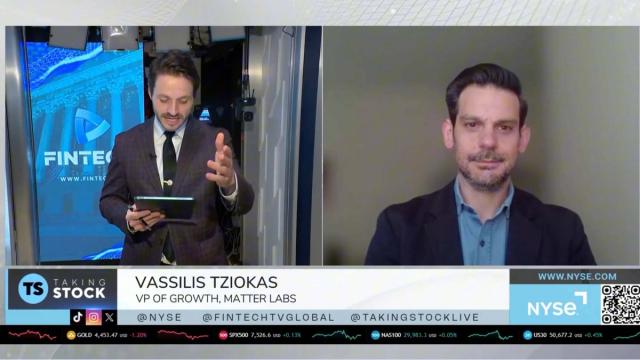
VideoWhy privacy is the key to bringing banks onchain | Vassilis Tziokas, Taking Stock NYSE
Vassilis Tziokas, VP of Growth at Matter Labs (ZKsync), joins Taking Stock live from the New York Stock Exchange to explain why privacy has been the primary blocker for institutional blockchain adoption, how Prividium gives banks a private, compliant, and interoperable environment to move onchain, and where tokenized deposits fit alongside stablecoins — including Matter Labs' partnership with the Cari Network and five U.S. regional banks.
May 28, 2026