


Published Mar 18, 2026
Institutions can build privately and compliantly onchain without sacrificing control | Omar Azhar, Nasdaq Trade Talks
Transcript
00:00:01:04 - 00:00:20:21 Welcome to Nasdaq Trade Talks with your host Jill Malandrino, global markets reporter at Nasdaq. Coming to you live in New York City from SmartCon. Joining me for the segment, we have Omar Azhar. He's Vice President of Business Development at Matter Labs. We're here to discuss the convergence of stratified ZK infrastructure and how tokenization will unfold over the next few years.
00:00:20:21 - 00:00:39:07 Omar, it's great to have you with us. Thank you for Nasdaq Trade Talks. And before Matter Labs you worked at EY in the technology group, capital markets and so forth. What was the inspiration behind transitioning over to this space? Yeah, so working for EY, I was there for a little over a decade in consulting, banking and capital markets.
00:00:39:09 - 00:01:03:28 It really gives you a very good insight — a look at how the nitty gritty infrastructure actually works. So the first half, the first five years, I was building quant risk models, both for the banking side and the lending side, and went through the whole CCAR, Dodd-Frank modernization, data transformation. And then the second half, when the first LLMs started coming out, I was working on that and trying to bring large transformational projects.
00:01:03:28 - 00:01:20:22 Like, how do you use AI? So it gave a really good view on — okay, this is very difficult to do for any bank or financial institution to take on a new tech transformation or new technology and enter into a new era. It's a multi-year process. The reason for that is really because each bank has thousands of systems.
00:01:20:22 - 00:01:36:10 They don't necessarily talk to each other. It's all batch processing. A CFO to get a quarterly report can take weeks. So no one really has a bird's-eye view of what's actually happening at any one time. Which essentially means, for someone like me in my day to day, it's very hard to actually adopt new technologies or due process.
00:01:36:16 - 00:01:53:15 It can take months or even years. At the same time, during those days, I was actually investing, trading and diving a little bit into crypto. It didn't really make sense to me what the purpose of the technology was at that point. But then when DeFi Summer came along, 2021–22, and you actually had usable applications —
00:01:53:16 - 00:02:11:10 these applications are composable. These things can move from one application to the other, and there's multiple utility in all this stuff. And then I was mostly on the Ethereum side of the blockchain world. It clicked for me that this stuff I was almost treating as a hobby and just exploring and spending some time on —
00:02:11:10 - 00:02:27:17 it actually does solve a lot of the problems that I'm facing in my day to day work at EY. And from there I felt that blockchain technology and Ethereum is like a step function up in terms of how we think about building financial products and how we think about information flows in the banking or capital markets world.
00:02:27:19 - 00:02:41:12 And I was like, I have to dive deep in because this is definitely the future. And I saw it — and I felt that I could probably do this, and I have not looked back since then. I mean, it has to be refreshing, removing a lot of those silos, right?
00:02:41:18 - 00:02:58:29 Absolutely. So that push to scale real world assets on chain and tokenization and so forth is starting to gain traction. What do you see as the most compelling drivers right now for institutions to adopt this model? Yeah, I think for any new technology, it has to impact the bottom line and it has to be very clear how it impacts the bottom line.
00:02:59:02 - 00:03:20:20 And I think the two biggest ones I can think of right now for institutional adoption of tokenized assets are: on the first hand you have efficiency gains, and on the other you have this whole new potential in business growth through the composability of tokenized assets. On the efficiency side, you can think of it as — right now, trade settlement —
00:03:20:22 - 00:03:42:24 you still have T+1, T+2, T+5 depending on the trade and different counterparties. By tokenizing those assets and tokenizing the activities on chain, you kind of almost take care of all the settlement issues, which also then means reconciliation. I think there's plenty of data that shows reconciliation cost is about 30 or 40% of back office costs.
00:03:42:27 - 00:03:59:06 Now imagine if you take all that out and said you could use it for productive means instead. So that already is going to impact your bottom line just from efficiency gains. However, for a big tech transformation, you're never going to sell it based on just the efficiency gains, right? It has to actually open up new avenues of growth. And this is where tokenized assets are also phenomenal.
00:03:59:06 - 00:04:19:20 And we've seen that so far this year and starting last year with tokenized money market funds. Now people are moving other types of assets on chain as well. And the real value of this is not so much that it's tokenized now and it can run 24/7. But the composability of that nature — all of a sudden you're giving additional utility layers to these assets that weren't possible before.
00:04:19:20 - 00:04:37:11 Because a tokenized asset, you can move in and out into any type of on-chain markets that these assets were not being used in at all. For example, take tokenized money market funds. Initially they came on and it was mostly on-chain treasuries investing because now they can invest in safe money market funds rather than just holding their assets in stablecoins.
00:04:37:14 - 00:04:54:21 Now all of a sudden we're talking about on-chain treasury management for large corporates. What does that really mean? Well, instead of holding assets in — like a large corporate like Google or Amazon — across thousands of bank accounts, they don't have access to 24/7 money movement even internally. And so they have to hold a buffer.
00:04:54:23 - 00:05:10:22 And that buffer could be anywhere from 20 to 30% of their balance sheet. That's just idle capital. That's not doing anything. It's essentially a cost. But if banks tokenize their deposits, now you can start building things 24/7. You don't need to hold such a large buffer if you're the treasury function of a large corporate.
00:05:10:24 - 00:05:29:03 But on top of that, you can also have a money market fund, and all of a sudden you're doing cash sweeps instantaneously. So anytime assets — your cash — are just sitting there, it's earning yield by being in a money market fund. And anytime it needs to move around, you immediately swap it for a tokenized deposit or a stablecoin, and you can make payments.
00:05:29:05 - 00:05:51:08 So that's a real world example of how the composability of tokenized assets is actually going to change a lot of finance. And this is great for the banks, because with 24/7 money movement, they can compete against stablecoins. But it's also great for large corporate customers because all of a sudden you've made a function that was previously considered a cost —
00:05:51:08 - 00:06:08:27 now actually revenue generating. Yeah, it's so interesting because you said we understand blockchain drives efficiencies, but what's the real value? Exactly. That's a conversation we're having around AI right now as well. Yeah, exactly. I just think it's interesting, that connection there. Let's take a step back. Let's talk about ZKsync and Matter Labs.
00:06:08:28 - 00:06:29:05 You focus on building modular, secure, ZK-powered infrastructure. What sets you apart in enabling large-scale applications? Yeah, so I think we like to say we're building incorruptible financial infrastructure. Why is it incorruptible? Because verifiability is incredibly important. Can you verify your solvency? Can you verify what you're doing is actually correct?
00:06:29:05 - 00:06:48:29 Can you verify this trade actually settled? Can you verify you actually have the assets? But can you do that without actually revealing your data? And that's what we're doing with ZKsync — with zero-knowledge proof technology — essentially being able to verify to anyone that yes, what I am doing is correct and these are the assets that I actually have, but I don't need to show you any data.
00:06:49:01 - 00:07:08:19 And what does that actually mean from a practical standpoint? We are essentially enabling institutions to come on chain onto Ethereum, but on their own terms — essentially build a Layer 2 with ZK infrastructure. It's fully scalable. Now with our latest Boojum upgrade, scalability is no longer a problem statement. Now there's privacy — you completely own everything about it.
00:07:08:19 - 00:07:32:25 You can design who can come in. You can have compliance and privacy. You have selective disclosure for regulators or third parties. And the nice part is it's very cost efficient and cloud scalable. You could do anything from a small application to a very large 15,000+ TPS or Visa-scale application, all within the same Layer 2, and have interoperability with Ethereum as well as with potentially your counterparty.
00:07:32:28 - 00:07:51:26 So you can directly access the liquidity that's sitting out there. You don't have to bootstrap your own liquidity. So you have your own execution environment — for this type of transaction or DeFi use case, where for compliance and privacy you don't want to interact publicly. And that's really what we're enabling. A good example of this would be, back to tokenized deposits —
00:07:51:28 - 00:08:10:23 we're working with a lot of different banks that want to start moving into a public space. But what do you need for that? Well, one, they would like to build on top of a large capital markets infrastructure. But this has to stay within the four walls of a bank, which means you need privacy. You need full ownership of the execution environment and the blockchain.
00:08:10:25 - 00:08:29:06 And we're providing that. And this is essentially going to be infrastructure that connects the core banking infrastructure — enabling them to start moving money 24/7. And then you can start going into composable DeFi and say, okay, how do I expand my services to my customer base?
00:08:29:08 - 00:08:59:07 Help us understand the ecosystem a bit more here. You work closely with infrastructure providers like Chainlink to ensure secure data and cross-chain interoperability. How do collaborations like that help to advance scalability and interoperability? So I would say there are multiple layers from a technology and product standpoint that you have to consider when you are doing scalability and interoperability.
00:08:59:07 - 00:09:18:11 It's not just purely — can I move data around very fast. It's also — can I move data around very fast in a compliant manner, with KYC, with transaction monitoring, with all the other additional bells and whistles that we don't normally think about when we're actually building these products, but you have to have them in place. And so we've been working with Chainlink and that team for a number of years.
00:09:18:17 - 00:09:40:13 It's been a very great partnership. They help bring in all the different additional layers like the orchestration layer. They also have CCIP for interoperability as well. And they essentially help you get from 0 to 1 very quickly because everything is already there. So we come in building with the incorruptible infrastructure — the blockchain infrastructure and interoperability, access to liquidity.
00:09:40:17 - 00:10:05:20 And they also come in with a lot of other things, for example, oracles, data feeds, and all the other things that you need to actually move something into production very quickly. It helps a lot with kickstarting the product space. So when you think about the convergence of ZK infrastructure and tokenization, what does that look like as you think about the next 2 or 3 years? What are some of the key milestones we should be watching?
00:10:05:20 - 00:10:29:02 I think one very obvious one to me is, how do you integrate the on-chain world with the existing reporting infrastructure? That is something that I think players like Chainlink and others are going to solve. And without that, it's very hard for most of the market to change because there are different requirements, different financial reporting requirements.
00:10:29:08 - 00:10:51:13 How do you translate on-chain transactions into that same world? I think that's one thing that needs to be done on the infrastructure side. I think what you'll start to see is we're going to start moving a lot of these projects — right now currently with banks on things like tokenized deposits — from MVP and testnet into production, and start moving their corporate clients into on-chain treasury management solutions.
00:10:51:16 - 00:11:12:09 You'll start to see that go into production in the coming months. And that's purely on the private blockchain side of the house. On the public blockchain side, I think we already have over $2 billion in private credit assets through Tradable, that's on one of our mainnets. You'll start to see that also being more fully on-chain.
00:11:12:09 - 00:11:35:12 What I mean by being fully on-chain is the distributions on the underlying assets and their cash flows are moving on chain. So you have much more transparency in these private credit loans that doesn't necessarily exist that well in the current paradigm. And once that happens, all of a sudden you can start using that as collateral — on Aave, for example — and now you've got additional utility for these assets.
00:11:35:18 - 00:11:57:03 So when that starts to happen — and it'll be very, very soon, we're talking weeks and months, not years anymore — the pace of innovation is rapid. In the last 12 to 18 months, the conversation has shifted very much. A lot of that is understanding the regulatory framework in your operating environment, especially coming from a capital markets background and having that experience.
00:11:57:06 - 00:12:13:12 You're able to understand the convergence of what needs to happen in order to execute on that. Without having that framework, you can't get anywhere. Yeah, I think one of the great things I've learned from my past life is these tech transformations that are step-function changes in how the world operates —
00:12:13:15 - 00:12:31:22 they generally run in five-year cycles. And I would say ZKsync, as well as the industry in general, has seen improvements across the board — growth rate, performance, points of scalability, the underlying tech itself, the usability, the user experience — but also in the use cases and the business value.
00:12:31:22 - 00:12:50:15 I think previously it was — okay, DeFi is very cool. And then — okay, stablecoins are very cool. Now all of a sudden — wait, there are all these other types of tokenized assets you can bring on chain. And you're starting to see that rapid shift. I think it's going to continue being a 10x each year, which is really exciting from a business value point — like, okay, how do you actually make money?
00:12:50:16 - 00:13:08:25 How do you actually use this hard technology? How do you use it in a way that your regulators are comfortable with, your shareholders are comfortable with, and everyone sees the value? So that's very exciting. Yes — we get the efficiency, but where is the real value? Exactly right. We appreciate the insight. Thanks for giving us some great talk.
00:13:08:28 - 00:13:13:02 And thanks for joining me.
Omar Azhar, VP of Business Development at Matter Labs, joins Nasdaq Trade Talks live from SmartCon to discuss the convergence of ZK infrastructure and tokenization. Drawing on over a decade of experience in capital markets at EY, Omar breaks down why institutions are at an "adopt or die" moment — and how tokenized assets unlock both efficiency gains and entirely new revenue streams. He explains how ZKsync enables banks to build private, compliant Layer 2 chains on Ethereum without sacrificing control or privacy. From tokenized deposits to on-chain treasury management, Omar outlines the key milestones to watch as institutional blockchain adoption moves from testnet to production.

 Video
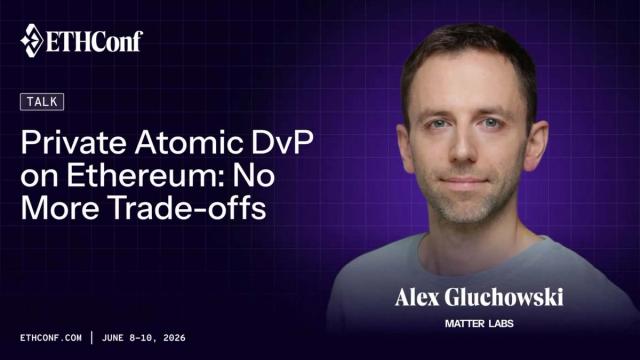
VideoPrivate Atomic DvP on Ethereum: No More Trade-offs
Alex Gluchowski (CEO, Matter Labs) on how Prividium makes atomic delivery-versus-payment possible between private bank zones, settled on Ethereum with cryptographic proof.
Jul 21, 2026

 Video
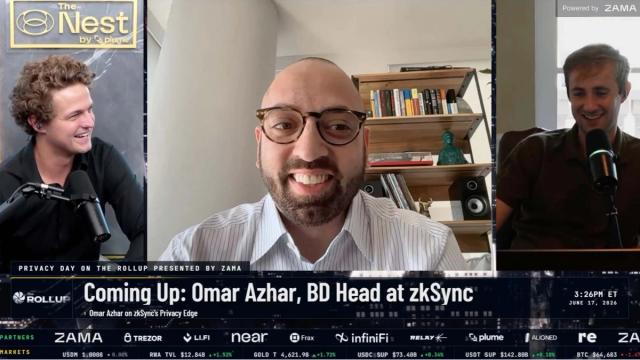
VideoWhy privacy is bringing institutions onchain. Omar Azhar, The Rollup Privacy Day.
Omar Azhar, Head of Business Development at Matter Labs (ZKsync), joins The Rollup's Privacy Day to explain why institutional adoption has accelerated sharply over the past six months, why privacy is the first gating criterion for banks moving onchain, and how Prividium gives institutions a private, compliant environment to run their own chains — including how private atomic interoperability connects them into bank networks alongside tokenized deposits and stablecoins.
Jun 18, 2026

 Video
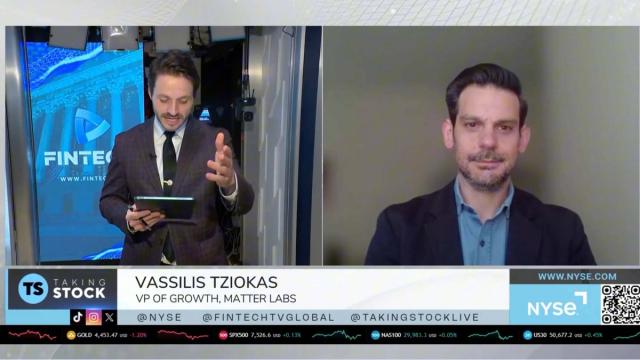
VideoWhy privacy is the key to bringing banks onchain | Vassilis Tziokas, Taking Stock NYSE
Vassilis Tziokas, VP of Growth at Matter Labs (ZKsync), joins Taking Stock live from the New York Stock Exchange to explain why privacy has been the primary blocker for institutional blockchain adoption, how Prividium gives banks a private, compliant, and interoperable environment to move onchain, and where tokenized deposits fit alongside stablecoins — including Matter Labs' partnership with the Cari Network and five U.S. regional banks.
May 28, 2026