


Published Apr 2, 2026
Tokenized Deposits: The Gateway to Mass Adoption | DAS NYC 2026 | Day 3 | Main Stage
Transcript
Speakers:
- Speaker 1: Moderator
- Speaker 2: Jake (BitGo)
- Speaker 3: Alex Gluchowski (Matter Labs / ZKsync)
00:00:00 Speaker 1: Hello, everyone. Thank you for coming out so early on the last day. And this is the last day, but I think this is one of only two panels that have tokenized deposits in the title card. So it's a little bit under-discussed. So that's what we're going to be talking about today. But let's start off with some quick intros. Jake.
00:00:22 Speaker 2: So I'm Jake. For the last year at BitGo, I ran our ecosystem team. So that meant everything crypto native at an otherwise crypto native company. Prior to that, I have founded four different companies in the crypto space. I've been in crypto so long that I've been in and out of crypto twice and also founded other companies as well. But I just kept getting sucked back in. I always tell the story about the first time — we only have ten minutes, so I'll be really quick. The last time that I left, I showed up for a yoga class and my yoga instructor before the class began was shilling his bag to us. This is like 2021 DeFi summer. I'm like, ooh, like this has got to be a sell signal. Anyways.
00:01:00 Speaker 3: And I'm Alex Gluchowski, founder and CEO of Matter Labs. We are known as creators of ZKsync. We've been in this space for eight years, pioneering zero knowledge proofs on Ethereum, scaling Ethereum, and now focusing very heavily on the institutional space and helping it modernize and get up to speed with blockchains.
00:01:18 Speaker 1: Okay, lovely. So like I said, I think stablecoins tends to dominate and maybe tokenized deposits is under-discussed. So maybe for those who are not as familiar, let's do a quick primer on what tokenized deposits are. Alex, you can take this one.
00:01:35 Speaker 3: Absolutely. You can think of tokenized deposits as a banking equivalent of a stablecoin. So it's something like a stablecoin issued by the bank that represents an IOU on the actual deposit. So you put money in your account, you get an equivalent amount of tokens on some blockchain, and then you can use it to transact, and then you can redeem it back into your bank. But the interesting thing that distinguishes it from a stablecoin is it is legally treated as a bank deposit. So you have the FDIC insurance, and you have all of the other properties of this deposit. And this matters for traditional finance and for all the interactions — for the structures of interactions. It's a different legal status.
00:02:25 Speaker 2: And if you think about it, we know banks take your deposits and they utilize them immediately upon deposit, and they don't have a one-to-one reserve of those assets held at the bank, which makes them more collaterally utilized than a stablecoin could ever be, because immediately they can cut off 30% of what they need to hold in that asset or have liquid in that asset. And that's where a lot of these banks make most of their money. And so stablecoins is always too narrow-visioned for how banks operate. Stablecoins make a lot of sense outside of banking infrastructure, which means global payments or participating in decentralized finance activities. When it comes to actually bringing the herd on chain, this would be the way it would happen.
00:03:20 Speaker 3: Exactly. And for the users of tokenized deposits, the upside is that the bank can be paying out yield the exact same way you would get yield on your normal deposits. And we have now this discussion of stablecoin yield versus banking yield. And this will be an important central piece in the conversation.
00:03:43 Speaker 1: Okay. So I mean, all of that makes sense, but we've had stablecoins for over a decade now. It's crazy to say that. So what's happening now? Why are banks now getting into tokenized deposits in a bigger way? And what problem is it solving?
00:03:57 Speaker 2: I'm going to let Alex go first.
00:04:00 Speaker 3: All the institutions now are moving towards tokenization and embracing blockchain technologies just because it's a better way to structure finance. It increases the velocity of money. You move from T+days to T+seconds. Instant settlement, 24/7 operations. All of the other upsides like fractionalization of all assets, instant PvP, DvP, exchange of assets against payment vehicles. That's an inevitable process, which has been massively accelerated by the regulatory clarity that we received this year. So all of the participants of the market understand that this is what their customers now expect and demand. And there is a race on who is going to move fast.
00:04:50 Speaker 2: Adoption is there. Tech is undeniable. A memo came out from the Treasury expecting — what was it — $6.3 trillion of outflows from deposits into stablecoins by 2035, I think was the year, which, like, that alone should shock you into action. And all of these financial institutions already had at least some guy, maybe a small team, maybe a bigger team working on this, tracking it, looking into it. Because as it became more and more of a threat to their business, they recognized that they need to do something to get up to speed. And what I think is alarming is how quickly these TradFi institutions ingested cryptocurrency and ingested blockchain technology and got themselves up to where we just spent the last fifteen years building towards. It's alarming. And when we were submitting names for the title of this presentation, my suggestion was "Tokenized Deposits: The Death of TradFi" because in my mind, very quickly, they're not going to be TradFi anymore. They're going to be doing the exact same on-chain transactions that we have been doing, that other large institutions within the crypto space have been doing, because they're building these rails to take their off-chain assets and move them on chain, and they're doing it rapidly.
00:06:16 Speaker 3: And now the pressure is building up not only from these external forces, but also from other players who are moving faster. So I was just last week on stage in Washington, where we announced the partnership with the Cari Network, who is doing tokenized deposits for five or six regional US banks. And this is just the beginning. And they're going to accelerate — they have, I believe, 150 banks in the waiting queue who want to join. Everyone now received the message: they have to move fast or they're going to be left behind, because the race is on.
00:06:58 Speaker 2: And what I've learned from my past — I think it's two and a half years at BitGo now. My largest team prior to getting acquired by BitGo was twelve. And so it was very startup focused, small team, move quick, make a lot of decisions, and mostly unregulated. BitGo has gotten to this point now where we are pretty heavily regulated. I mean, we are a federally licensed OCC charter bank, and we have our shares out in public markets. So we are getting viewed from both angles quite tightly, and that's a tough place to build net new products — maybe more so for us than for others, because it's a new thing to us rather than an existing thing. But what you cannot discount is the amount of money these guys have. And abilities can be bought and growth can be bought. I mean, products can just be bought. They can absorb Matter Labs, they can absorb BitGo. And all of a sudden there is no gap. The gap disappears.
00:07:58 Speaker 1: So with that OCC charter that gives you custody — I know ZKsync has a solution. Maybe you can elaborate on that a little bit more very briefly, but this partnership between you bringing that component of custody, again with ZKsync's Prividium™. How does bringing these components together work? How does that help with real world adoption for tokenized deposits?
00:08:21 Speaker 3: So the partnership is about giving banks and financial institutions the full-stack solution that they can just plug and play in their existing processes. And this involves the blockchain infrastructure, which starts with Prividium™, which is a private blockchain operated by the bank with full privacy, full control, meeting all of the compliance requirements because it runs on their infrastructure, completely under their management and control. And it's secured with zero knowledge proofs and connected to Ethereum and to other institutions. But that's just the infrastructure layer. And on top of that, they need custody, they need wallets, they need institutional-grade tools to operate all of the processes of tokenization. And then actually using these tokens and connecting and integrating them into their systems. And this is where partners like BitGo are extremely important — as a public company, long time in the space, highly respected, very high security track record. It's the type of partner, the level of maturity, that these institutions expect.
00:09:37 Speaker 2: We sit in this beautiful but awful place where we are both a bank and a crypto company. But because of that, we've learned exactly the types of things that these large institutions that we're speaking with need to do to get their tokenized deposits to be at least at parallel to the previous non-tokenized versions. And then that's where the actual efficiencies start kicking in. And that's where they're able to see how much more value a 24/7, instant settlement, selectable privacy environment can bring them.
00:10:14 Speaker 1: Okay. Awesome. Well, that's our time. And you've heard it. If you've been sleeping on tokenized deposits, definitely check it out. I think we are going to be in a future where both stablecoins and deposits exist. So thank you to our panel.
00:10:25 Speaker 2: Tokenized deposits are honestly the last frontier. This gets figured out — banks are no longer banks. Banks are crypto institutions.
00:10:35 Speaker 1: 100%. Thank you for your time. Thank you everybody.
00:10:38 Speaker 4: Thank you.
Jake (BitGo) and Alex Gluchowski (Matter Labs/ZKsync) break down tokenized deposits — how they differ from stablecoins, why banks are racing to move on chain, and how the BitGo x ZKsync partnership gives institutions a full-stack solution with Prividium™ for private, compliant, instant settlement.

 Video
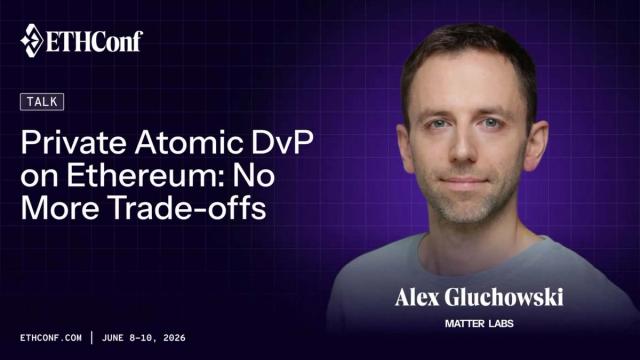
VideoPrivate Atomic DvP on Ethereum: No More Trade-offs
Alex Gluchowski (CEO, Matter Labs) on how Prividium makes atomic delivery-versus-payment possible between private bank zones, settled on Ethereum with cryptographic proof.
Jul 21, 2026

 Video
VideoWhy privacy is bringing institutions onchain. Omar Azhar, The Rollup Privacy Day.
Omar Azhar, Head of Business Development at Matter Labs (ZKsync), joins The Rollup's Privacy Day to explain why institutional adoption has accelerated sharply over the past six months, why privacy is the first gating criterion for banks moving onchain, and how Prividium gives institutions a private, compliant environment to run their own chains — including how private atomic interoperability connects them into bank networks alongside tokenized deposits and stablecoins.
Jun 18, 2026

 Video
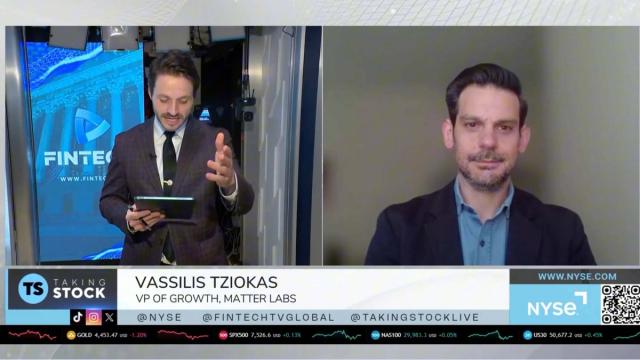
VideoWhy privacy is the key to bringing banks onchain | Vassilis Tziokas, Taking Stock NYSE
Vassilis Tziokas, VP of Growth at Matter Labs (ZKsync), joins Taking Stock live from the New York Stock Exchange to explain why privacy has been the primary blocker for institutional blockchain adoption, how Prividium gives banks a private, compliant, and interoperable environment to move onchain, and where tokenized deposits fit alongside stablecoins — including Matter Labs' partnership with the Cari Network and five U.S. regional banks.
May 28, 2026